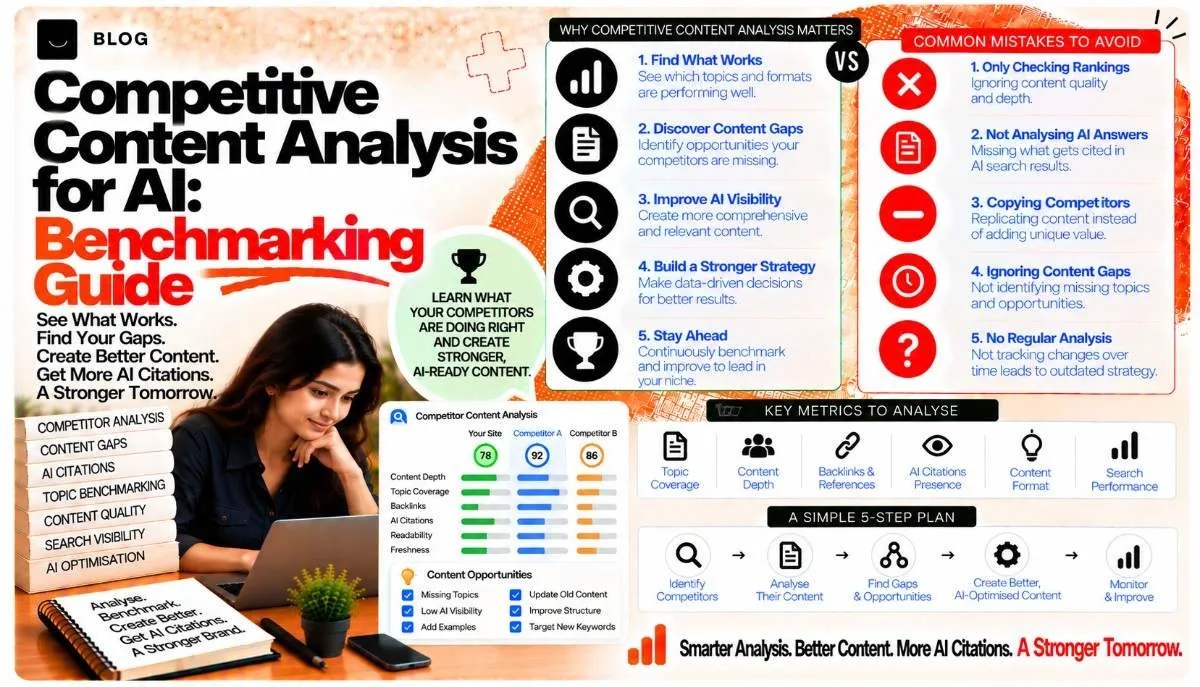
Competitive Content Analysis for AI: Benchmarking Guide
You have good content. But is it better than your competitors' content? And more importantly, is it the kind of content that AI systems prefer to cite?
Traditional competitive analysis was about keywords: who ranks for what, what's their domain authority, how many backlinks do they have? That approach still matters, but it's incomplete for AI systems.
AI systems don't just compare keyword coverage. They compare content comprehensiveness, structural quality, depth, recency, and credibility signals. A competitor might rank for a keyword with mediocre content that AI systems rarely cite. Meanwhile, another competitor might not rank for that keyword but has superior content that AI systems cite frequently.
Competitive content analysis for AI means understanding what your competitors are doing well (from an AI perspective) and what they're missing. This guide covers how to do that.
What competitive content analysis means for AI systems
Competitive content analysis has shifted from "who ranks?" to "who gets cited?"
Traditional analysis:
- Which competitors rank for my target keywords?
- How many backlinks do they have?
- What's their domain authority?
- Where are their content gaps?
AI-focused analysis:
- What content do AI systems cite competitors for?
- How comprehensive is competitor content vs. mine?
- What content structure do AI systems prefer?
- Where are the gaps between what competitors cover and what AI systems search for?
This distinction matters because a page can rank well in Google but rarely be cited by AI systems, or vice versa.
Step 1: Identify your direct competitors for AI visibility
Your AI visibility competitors might not be your Google ranking competitors.
AI visibility competitors are sites that:
- Target the same topics as you
- Are cited by AI systems for those topics
- Have established authority in your niche
How to identify them:
- Ask ChatGPT, Perplexity, and Google's AI — search your target topics and note which sites are cited
- Use Semrush or Ahrefs — look at organic traffic competitors (sites getting traffic for similar keywords)
- Check backlink profiles — sites with similar link profiles usually compete for similar topics
- Analyze your Google Search Console — which sites appear in queries where you rank?
Create a competitor list:
- Competitor 1: [Domain], cited for topics: [List]
- Competitor 2: [Domain], cited for topics: [List]
- Competitor 3: [Domain], cited for topics: [List]
Focus on 3–5 direct competitors; analyzing too many becomes unmanageable.
Step 2: Audit competitor content comprehensiveness
For each competitor, evaluate how comprehensively they cover your target topics.
Checklist for each topic:
- Main post depth — how long is their primary post? (word count, number of sections)
- Subtopic coverage — do they cover major subtopics within the main topic?
- Format variety — do they use multiple formats (text, lists, tables, FAQs, examples)?
- Recency — when was it last updated?
- Credibility signals — do they include author bylines, credentials, data sources?
Example: Analyzing competitor content on "Entity SEO"
| Metric | Your Content | Competitor A | Competitor B |
|---|---|---|---|
| Main post word count | 2,500 | 3,200 | 1,800 |
| Subtopic coverage | 5 subtopics | 8 subtopics | 3 subtopics |
| Includes FAQ section | Yes | Yes | No |
| Includes schema examples | Yes | Yes | No |
| Last updated | Oct 2026 | Aug 2026 | Dec 2025 |
| Author bio | Yes | No | Yes |
This reveals gaps: Competitor A has better subtopic coverage and more depth. You and Competitor B are missing something Competitor A has. Competitor B is outdated.
Step 3: Analyze what AI systems cite competitors for
This is the key distinction: what are AI systems actually citing?
Method 1: Manual AI search
- Search your target topics in ChatGPT, Perplexity, Google's AI
- Note which competitor content is cited
- Look for patterns: which content formats, angles, and types are cited?
Example:
- Search "how to implement entity SEO"
- Note that Competitor A's post is cited
- Competitor B's post is not cited
- Question: Why is Competitor A cited and not Competitor B?
- Answer: Competitor A's post has a step-by-step section; Competitor B's doesn't
Method 2: Analyze citation patterns
- Is Competitor A cited for tactical content (how-tos) or strategic content (frameworks)?
- Is citation high for new content or old content?
- Are certain content formats cited more (guides vs. comparisons)?
Step 4: Identify content gaps in competitor coverage
Gaps are opportunities. Where competitors aren't covering something (or are covering it poorly), you can create better content.
Types of gaps:
Format gaps
- Competitors cover a topic in a blog post, but no comparison guide exists
- You create the comparison guide
Angle gaps
- Competitors cover Entity SEO from a technical angle
- No one covers it from an AI-specific angle
- You create the AI-focused Entity SEO guide
Depth gaps
- Competitors cover Entity SEO in 2,000 words
- No comprehensive guide exists (3,000+ words)
- You create the comprehensive guide
Recency gaps
- Competitors' top content is from 2023
- It's outdated but hasn't been updated
- You create a 2026-updated version
Niche gaps
- Competitors cover Entity SEO for e-commerce sites
- No one covers it for local service businesses
- You create the local-service-focused guide
How to find gaps:
- List competitor subtopics and angles
- Note what's missing
- Search whether anyone covers those missing subtopics
- If not, or if coverage is poor, that's your gap
Step 5: Create a competitive content matrix
Organize your findings in a matrix so you can see at a glance where you stand.
| Topic | You | Competitor A | Competitor B | Your Advantage |
|---|---|---|---|---|
| Entity SEO basics | 2K words | 3K words | 1.5K words | Gap: comprehensive update |
| Entity SEO for AI | Yes | No | No | Advantage: unique angle |
| Entity SEO for local services | No | Yes | No | Gap: create this content |
| Entity SEO case studies | Yes | Yes | Yes | Tie: need better case studies |
This matrix shows:
- Where you're ahead
- Where you need to improve
- Where you have unique content opportunities
Benchmarking beyond content
Competitive analysis also includes non-content signals:
Authority signals:
- Backlinks (number and quality)
- Brand mentions
- Media coverage
Credibility signals:
- Author credentials
- Certifications and awards
- Company size and history
User signals:
- Time on page
- Bounce rate
- Social shares
Recency signals:
- Last updated date
- Posting frequency
- News and updates
AI systems evaluate all of these. If your content is newer, more authoritative, and has better credibility signals, it will be cited more often than older competitor content.
Frequently asked questions
Quarterly is ideal. Content landscape changes, competitors update, and AI systems' preferences evolve. Every 3 months ensures you stay competitive.
Start with direct competitors (same niche), but also look at adjacent niches. A site in adjacent niche might have superior content structure you can learn from.
Indirectly. Analysis reveals gaps you can fill and improvements you can make. Those changes improve citation.
Analyze Google competitors (who ranks for your keywords) and estimate their AI citation rate by searching AI systems. This gives you baseline benchmarks.
No. Use competitive analysis to understand what's missing, then create original content that fills gaps better than competitors do.
Search your target topics in AI systems and count citations. Over time, if you're cited more, you're winning.
Ready to build what's next?
Tell us where you're headed. We'll come back with a plan to get there.
Book an intro call