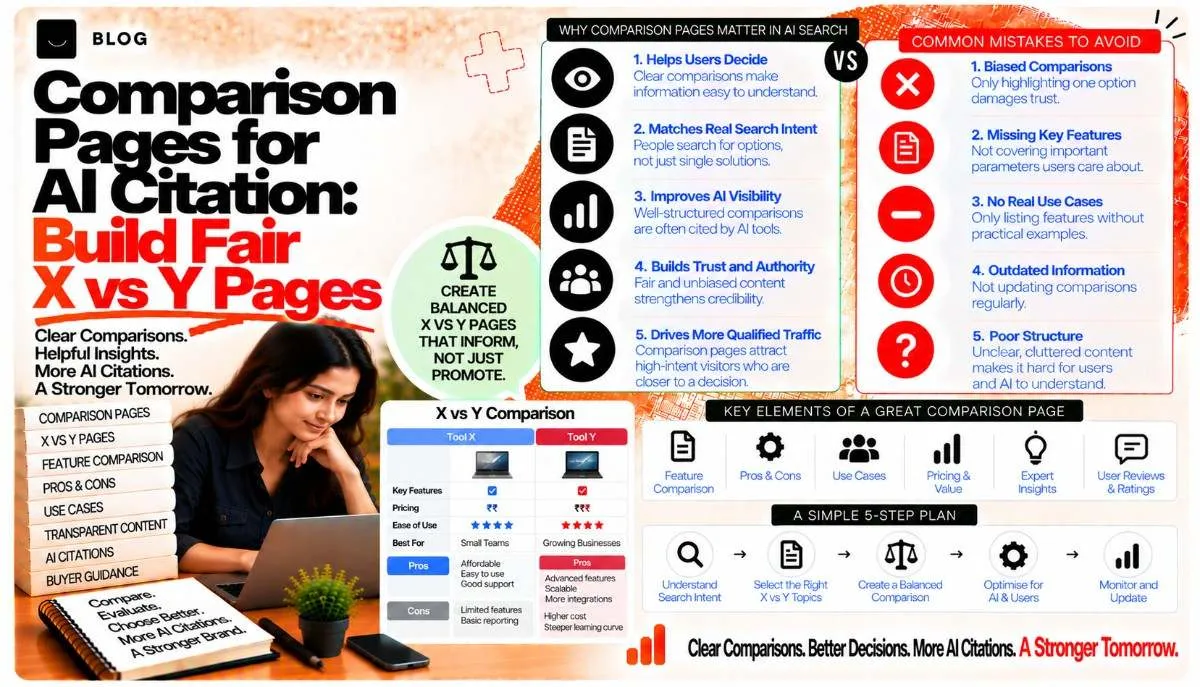
Comparison Pages for AI Citation: Build Fair X vs Y Pages
Someone choosing between two tools, two agencies, or two approaches often asks an AI system which is better. The answer depends on their situation, so a good response lays out the trade-offs, names the criteria that matter, and points to where each option fits. The sources an AI system uses for that answer are usually comparison pages.
Most comparison pages fail that job. The brand publishing them compares itself favourably against a rival with a table where every row favours the publisher. AI systems and buyers both notice. A comparison that is useful to a buyer, including the points where the competitor is the better choice, is more credible and more likely to be cited.
This guide covers how to build comparison and alternatives pages that are accurate, fair, and structured so an AI system can extract them without distorting the content.
Why comparison pages are cited
When a user asks an AI system to compare options, the response needs criteria, trade-offs, and a sense of who each option suits. Comparison pages supply all three in one place. They are a natural source because they are written to answer exactly that question.
Three features make a comparison page citable:
- Explicit criteria. The page names what it is comparing: price, features, coverage, support, and so on.
- Balanced trade-offs. The page says where each option is stronger, not only where the publisher is.
- Verifiable facts. The page states specific, checkable details, with dates, and links to the source of each claim.
A comparison page that does all three can be quoted accurately. A page that does none of them is rarely quoted at all, or is quoted and then contradicted.
Decide whether a comparison page is the right format
Before building a comparison page, check that it serves a real need. Good candidates are:
- A comparison that many buyers actually search for, such as "[your product] vs [competitor]" or "[category] alternatives."
- A decision that depends on criteria a buyer can evaluate, such as price tiers, supported features, or service areas.
- A question where your business has honest expertise, so you can explain trade-offs credibly.
Weak candidates include comparisons with a competitor nobody searches for, comparisons between options that are not genuinely alternatives, and comparisons where you cannot state the competitor's position accurately. If you cannot describe a competitor fairly, a comparison page is the wrong format for that pair.
The search intent mapping post covers the planning side of choosing which intents to target. This post covers building the page once you have decided to target a comparison intent.
Step 1: Define the criteria before writing anything
Start with a short list of criteria a buyer would use to choose. Five to eight is usually enough. Good criteria are specific, observable, and relevant to the decision.
For a software comparison, criteria might include pricing model, integrations, data export, support hours, and onboarding time. For a service comparison, criteria might include coverage area, minimum contract length, reporting format, and typical turnaround.
Avoid vague criteria such as "quality" or "best experience" unless you define them. Vague criteria cannot be checked, and an AI system cannot extract them accurately.
Step 2: Gather facts from primary sources
Every factual claim in the comparison should be traceable to a primary source: the competitor's published pricing page, documentation, terms, or a dated check you performed yourself. Record the source and the date you checked it.
Several practices protect accuracy:
- Check the competitor's current published information rather than relying on memory or old notes.
- Date every price and feature. Comparisons go stale quickly, and a dated page is easier to trust and to update.
- Note where information is not publicly available. Say so, rather than guessing.
- Test the product if you can. A hands-on check is stronger than a spec sheet.
If a competitor changes their pricing, your comparison should be updated. Keep a review date on the page.
Step 3: Show the competitor's strengths honestly
The most important rule of comparison writing is that every comparison must show where the competitor is stronger. If your page cannot name a single area where the other option is better, readers will not believe the rest of it.
Write a section for each option covering:
- Where it is strongest, with specifics.
- Who it suits best, described by situation rather than by flattery.
- Where it falls short, stated plainly.
Then describe your own option in the same format. Use identical structure for both, so the reader can compare them directly.
This is not a weakness in your marketing. It is what makes the page a trusted source. A buyer who finds your comparison fair will consider you more seriously, and an AI system that extracts a balanced summary will represent you more accurately.
Step 4: Structure the page for extraction
A comparison page should give an extractable summary near the top, followed by the detail.
A practical layout:
- A short introduction stating what is being compared and who the comparison is for.
- A summary table with the criteria as rows and the options as columns, each cell a short, factual statement.
- A "who should choose which" section, written as conditions: "Choose X if you need Y; choose Z if you need W."
- Detailed sections per criterion, each with the facts for each option and the source date.
- An honest verdict, framed as a decision guide rather than a single winner.
- Frequently asked questions, each answered in one or two sentences followed by detail.
The summary table is what many systems extract. Keep its cells short and factual. A cell that reads "Starts at [price] per month, billed annually; check current pricing page" is clearer than a long sentence.
Step 5: Use markup carefully
Schema markup can help describe the page's structure. The ItemList type can represent a list of options being compared, and FAQPage can describe the questions at the end. Use the Review type only for genuine reviews you have written with a real evaluation, and do not use Product markup to describe a competitor's product as if it were yours.
Common mistakes in comparison markup include marking up your own product's rating in a way that implies an independent review, and describing a competitor's features in markup you have not verified. Keep the markup to what the page actually shows, and check it with the Rich Results Test or the Schema Markup Validator before publishing.
{ "@context": "https://schema.org", "@type": "ItemList", "name": "Comparison of Tools for Local Business Listings", "description": "A comparison of three listing management tools on pricing model, integrations, and onboarding time, checked on the date shown on the page.", "itemListElement": [ { "@type": "ListItem", "position": 1, "name": "Tool A", "url": "https://example.com/tool-a-comparison" }, { "@type": "ListItem", "position": 2, "name": "Tool B", "url": "https://example.com/tool-b-comparison" } ] }
Step 6: Disclose affiliation and commercial relationships
If your business is one of the options being compared, say so clearly on the page, near the top. If you earn commission from any option, disclose that as well. Readers and regulators expect this, and undisclosed relationships are a credibility risk.
In India, the Consumer Protection Act and advertising standards bodies set expectations for fair comparative advertising. For any claim about a competitor, check the current rules that apply to your market and your claim, and take professional advice where a claim could be challenged.
Do not make claims about a competitor that you cannot substantiate. Accuracy is the protection, and it is also the thing that keeps the page citable.
Step 7: Update and maintain the page
Comparison pages go stale faster than most content. A competitor changes pricing, adds a feature, or discontinues a plan, and the page becomes wrong.
Set a review schedule:
- Check the facts against each competitor's current published information on a regular cycle, quarterly for fast-moving markets.
- Show the last-checked date on the page.
- Correct errors visibly, noting what changed and when.
- Retire the page if the comparison no longer matters to buyers or one of the options is discontinued, redirecting to a relevant current page where possible.
Keep the URL stable across updates, so links and citations continue to point to the same page.
Step 8: Measure the page's performance
Track the outcomes that show whether the page is serving buyers:
- Search impressions and clicks for comparison queries in Search Console.
- Engagement on the page, such as time on the decision guide section.
- Conversions from the comparison page to contact or trial pages.
- AI citation checks, asking AI systems the comparison questions and noting whether your page is among the sources, and how accurately it is summarised.
A comparison page that buyers trust should convert better than one that hides trade-offs, even if its raw traffic is lower.
What comparison pages cannot do
A comparison page cannot make a weak product competitive. If your option loses on the criteria buyers care about, a fair comparison will show that, and the better response is to improve the product or serve a different buyer.
It also cannot substitute for a clear decision guide on your site. The comparison works best when it leads to a resource that helps the buyer choose, including the case where they should choose someone else.
Common comparison page mistakes to avoid
Only showing your strengths. A one-sided table is recognised as marketing and is rarely cited.
Using outdated competitor information. Stale facts damage trust, and they can be challenged publicly.
Vague criteria. "Better support" is not checkable. "Support available by email on weekdays, 9 to 6 IST" is.
Undisclosed affiliation. Hidden commercial relationships are a credibility and legal risk.
Comparing with a competitor you cannot describe fairly. If you cannot state their strengths, do not publish the comparison.
Publishing and forgetting. Comparisons need a review cycle, or they become misleading.
Frequently asked questions
Fair, accurate comparisons are generally permitted in most markets, subject to rules on misleading claims and trademark use. Use competitor names factually, avoid implying endorsement, and take professional advice if a claim could be challenged.
Yes, if the page is genuinely about the comparison and the names are used factually. A comparison that avoids naming the alternatives is less useful and less likely to be cited.
Two is the clearest format. Three or four work for category comparisons, provided the summary table remains readable. Beyond that, a page becomes a directory and needs a different structure.
They can, because they answer the question buyers ask AI systems directly. The page is most likely to be cited when it is fair, dated, and structured for extraction.
Check the facts first, and correct any errors promptly and visibly. If the comparison is accurate and fair, you can respond calmly. Seek professional advice before taking any action on a formal complaint.
No. Compare the options buyers actually consider, and leave out those that are not genuine alternatives. A focused comparison is more useful than an exhaustive one.
Ready to build what's next?
Tell us where you're headed. We'll come back with a plan to get there.
Book an intro call