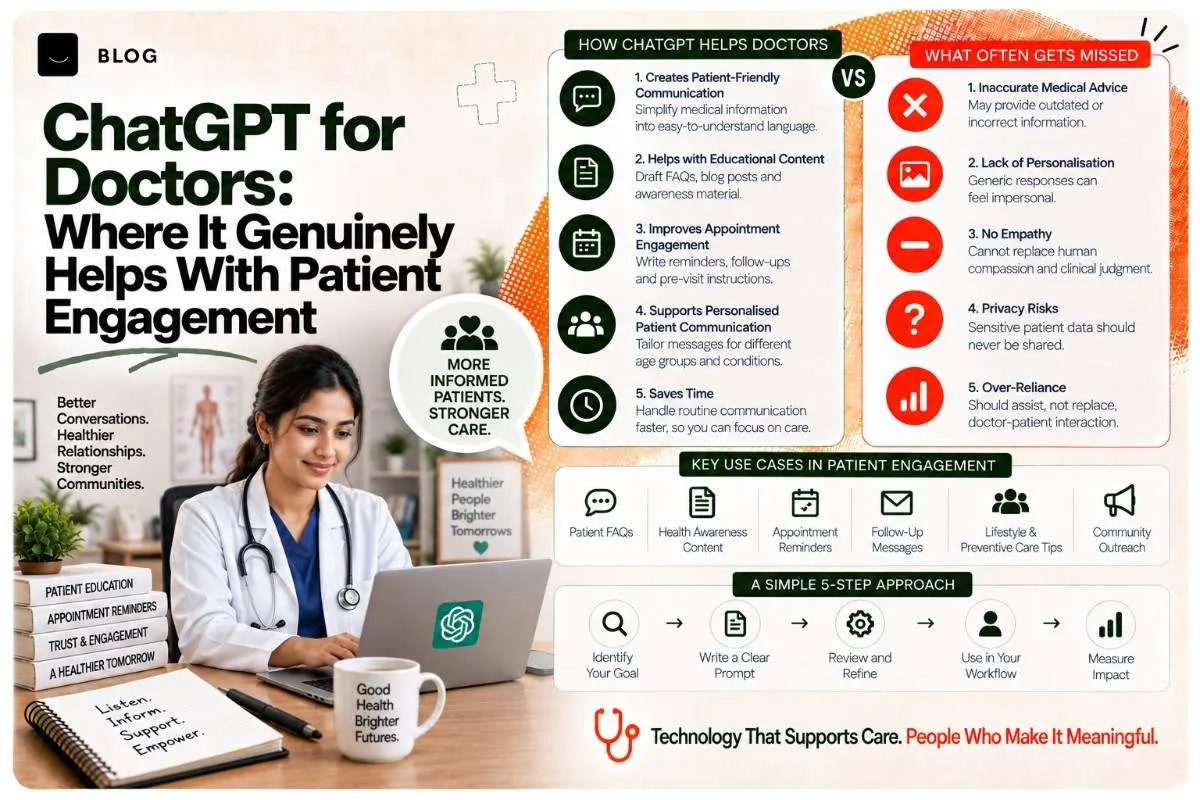
ChatGPT for Doctors: Where It Genuinely Helps With Patient Engagement
ChatGPT can meaningfully reduce the administrative load in a clinic — drafting appointment reminders, general health education content, and documentation support — without ever touching anything resembling diagnosis, treatment recommendation, or advice about an individual patient's condition. That distinction is not a formality. It is the entire boundary this post is built around, and it should be the boundary any clinic using AI tools maintains as well.
A note on scope, before anything else
This post covers general administrative and educational uses only. It does not cover, and should never be read as covering, AI use for diagnosis, treatment recommendations, medication guidance, or any response to an individual patient's specific symptoms or condition. Those uses sit in entirely different territory — clinically, ethically and from a professional conduct standpoint — and are outside what this post addresses.
Registered medical practitioners in India operate under professional conduct regulations governing advertising, solicitation and patient communication. This is not legal or professional guidance, and this post should not be treated as a compliance opinion. Practitioners should verify their own obligations against current regulations and, where there is genuine doubt, seek advice.
VERIFY: Before publishing, confirm this post's boundary — general education and logistics only, explicitly excluding anything diagnostic or advisory — against current NMC guidance, and consider a lawyer's or a practising doctor's review.
The line this post does not cross
Stated plainly and repeated because it matters more than anything else here:
Never use AI to respond to a patient's description of their symptoms, suggest a diagnosis, recommend a treatment, adjust a medication, or answer any question specific to an individual patient's condition. That is clinical judgment, and it belongs to the clinician, full stop, regardless of how confident or plausible an AI-generated answer sounds.
What this post does cover is a narrower, genuinely useful band of tasks: logistics, general education content that applies to anyone rather than a specific patient, and administrative support — none of which requires or implies clinical judgment about an individual case.
Where ChatGPT is genuinely useful in a clinic
Appointment logistics
Drafting reminder messages, rescheduling communications, and general pre-visit instructions — "please arrive 15 minutes early," "bring your previous reports" — that apply to any patient with an appointment, not to a specific person's condition.
General health education content
Explaining, in plain language, how a common procedure generally works, what a general category of test generally involves, or general wellness information — content that would be true and appropriate for any reader, published as general education rather than directed at one patient's situation. This is the same content a clinic might otherwise put in a printed pamphlet, drafted faster.
Administrative and documentation support
Drafting templates for common administrative correspondence, structuring general clinic information for a website or handout, and organising non-clinical scheduling or operational communication.
Post-visit instructions, in the patient's own words
Not clinical instructions specific to what was diagnosed or prescribed — those come from the clinician directly — but general logistical follow-up like "your next appointment is on X" or general aftercare information that applies broadly to a category of visit, reviewed and approved by the clinician before it goes to anyone.
A prompt template for general education content
For drafting general, non-patient-specific educational material only:
You are drafting general health education content for a clinic's patients. This content will be reviewed by a licensed doctor before publication and must not reference or respond to any specific patient's symptoms, diagnosis or treatment. TOPIC: [general health topic — e.g. "what to expect before a routine blood test," "general post-procedure care for X category of procedure"] AUDIENCE: general patients, no assumed medical background TONE: clear, reassuring, plain language Write general educational content that: - Applies to anyone in this general category, not a specific individual - Makes no diagnostic statements and no treatment recommendations - Clearly states that this is general information and does not replace advice from their own doctor - Is factually accurate to general, well-established medical knowledge Rules: - Do NOT include any claim, statistic or medical fact you are not confident is well-established and generally accurate. Where uncertain, write [VERIFY: doctor to confirm this claim] instead of stating it. - Do NOT write anything that could be read as advice for an individual's specific situation. - Include a clear statement that this is general information only.
The [VERIFY] instruction matters here more than almost anywhere else in this library, given the subject matter. A confidently wrong medical claim is a different category of problem from a confidently wrong marketing claim.
The review step that is never optional
Every single piece of AI-drafted content in a clinical setting — with zero exceptions, regardless of how routine it seems — is reviewed by a licensed clinician before it reaches a patient. Not spot-checked. Every piece, every time.
Specifically checking for:
- Any statement that drifts from general education into something that could be read as advice for an individual
- Factual accuracy of any medical claim, however general
- Every [VERIFY] flag, resolved before publication
- Tone appropriate to a medical context — reassuring without overstating certainty
- A clear statement, where relevant, that the content is general information and does not replace individual medical advice
What this looks like week to week
- Identify a genuinely general, recurring need — a reminder template, an educational topic patients ask about often, an administrative document.
- Confirm the topic is genuinely general and does not risk drifting into individual advice before drafting anything.
- Draft using the template above.
- Clinician review, every time, checking specifically for the five points above.
- Publish or send, with any needed disclaimer intact.
- Keep a simple log of what was drafted, reviewed and approved — useful both as a quality record and as evidence of a considered process if a question ever arises.
Frequently asked questions
For genuinely general, non-clinical communication — appointment reminders, general health education content, administrative logistics — yes, with every piece reviewed by a licensed clinician before it reaches a patient. AI should never be used to respond to an individual patient's symptoms, suggest a diagnosis, or recommend treatment, which remains clinical judgment belonging solely to the practitioner.
Only when the content is genuinely general — applicable to anyone in a broad category rather than responding to a specific patient's situation — accurately reflects well-established medical knowledge, is reviewed by a licensed doctor before publication, and clearly states that it is general information rather than individual advice.
No, and this should never be attempted regardless of how the request is framed. Diagnosis and treatment recommendation require clinical judgment specific to an individual patient's history, examination and context, which is the responsibility of a licensed clinician and falls entirely outside appropriate use of a general AI tool.
Anything involving an individual patient's specific symptoms, diagnosis, treatment, medication guidance, or any response that could be read as clinical advice for that person's situation. AI's appropriate role in this context is limited to general, non-patient-specific logistics and education, always reviewed by a clinician.
Every piece, without exception, checked by a licensed clinician for whether it has drifted from general information into something resembling individual advice, factual accuracy of any medical claim however general, resolution of any flagged uncertainty in the draft, and appropriate tone. Spot-checking is not sufficient given the stakes involved.
Generally yes, stating clearly that the content is general information and does not replace advice from the patient's own doctor. This is both good practice and a reasonable safeguard, though the specific requirement should be confirmed against current professional guidance rather than assumed.
No. This post describes a general approach to a narrow category of low-risk AI use and explicitly excludes anything diagnostic or advisory. It is not a substitute for verifying current professional conduct obligations directly, and any practitioner with doubt about a specific use should seek qualified advice before proceeding.
Ready to build what's next?
Tell us where you're headed. We'll come back with a plan to get there.
Book an intro call