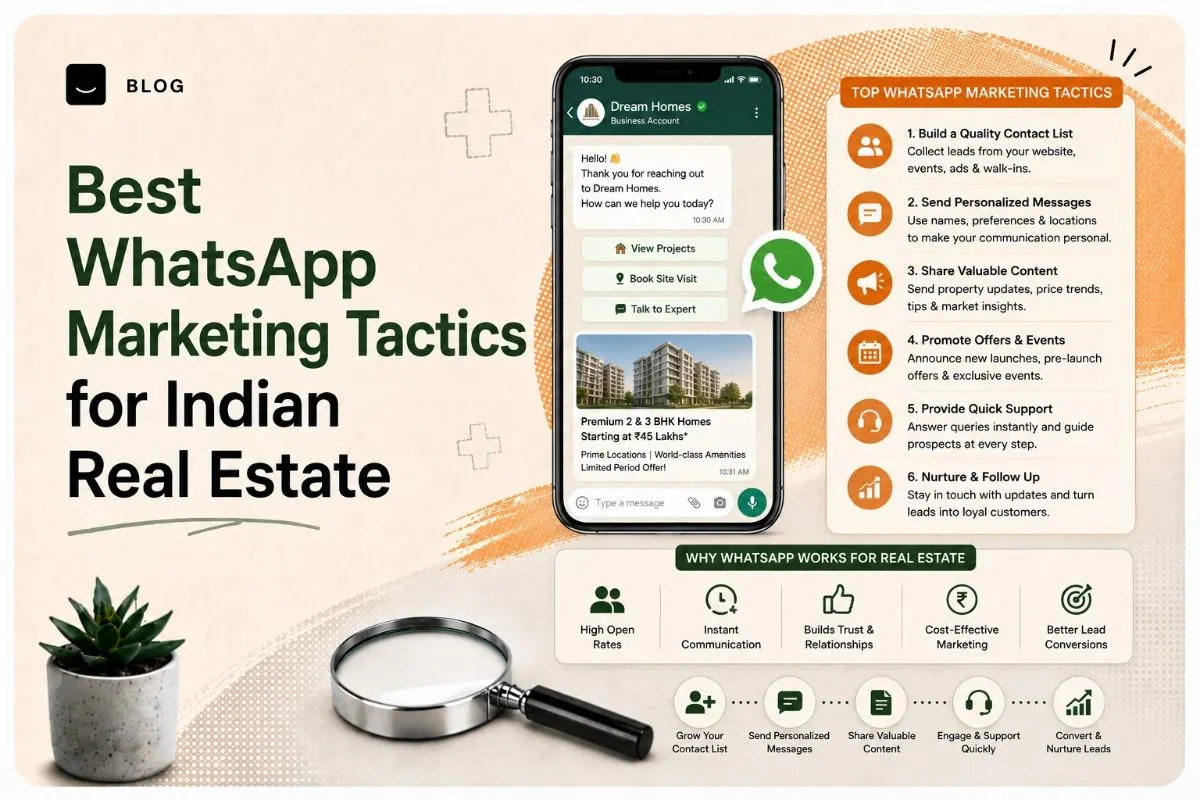
Best WhatsApp Marketing Tactics for Indian Real Estate
WhatsApp is where Indian property buyers actually respond. They ignore emails, screen unknown calls, and reply to WhatsApp messages within minutes — which makes it the highest-response channel most real estate businesses have, and the one most of them use badly.
The nine tactics below cover the whole journey: capturing the lead, qualifying it, sharing property, following up across a long decision cycle, and handing off to a human at the right time.
Why WhatsApp beats email and calls for property leads
Property buying in India is a long, high-value, conversation-heavy decision. Buyers ask a lot of questions over weeks or months before committing, and they want answers without commitment.
A phone call demands their full attention and feels like pressure. Email gets ignored. WhatsApp lets a buyer ask "is 3BHK available in this project?" at 10pm, get an answer, and keep thinking — with no salesperson breathing down their neck.
That low-pressure, asynchronous quality is exactly what a considered purchase needs. It's also where they already are. No app to download, no login, no portal — a channel every buyer already uses daily.
Before you start: get the setup right
Three things to sort before any tactic works:
- Use WhatsApp Business, not your personal number. You get a business profile, catalogue, quick replies, labels and away messages — none of which exist on the personal app.
- Complete the business profile properly — company name, address, website, working hours, and a description of what you do. This is the first thing a buyer checks to decide whether you're legitimate.
- Move to the WhatsApp Business API once volume outgrows manual handling. That's what enables automation, multiple agents on one number, and CRM integration.
1. Qualify leads with three questions, not twenty
Most agents either ask nothing and waste hours on unqualified buyers, or send an interrogation that kills the conversation.
Three questions do almost all the work: budget range, preferred location, and timeline.
Ask them conversationally, one at a time, and offer options rather than open text where possible.
For example: "Are you looking at 50L–75L, 75L–1Cr, or above 1Cr?" Tapping a choice is far easier than typing on a phone.
Everything else — financing, family size, floor preference — comes naturally once the buyer is engaged.
2. Send listings as a proper catalogue, not a wall of photos
Dumping fifteen photos and a PDF into a chat is the single most common mistake in real estate WhatsApp marketing. It's overwhelming, unsearchable, and looks unprofessional.
Use the WhatsApp Business catalogue instead.
Add properties as items with a clear title, price, location and a few strong photos. The buyer can browse at their own pace, and it stays accessible in your profile rather than scrolling away in chat history.
For a specific property, send one message with three or four strong images and the key details — price, size, location, one standout feature — then ask if they'd like to see more.
3. Use click-to-WhatsApp ads instead of lead forms
If you're running Meta or Google ads for property, send the click straight into a WhatsApp conversation rather than to a lead form.
Lead forms produce a name and number that then has to be chased by phone, with most calls going unanswered.
A click-to-WhatsApp ad starts an actual conversation with a buyer who is interested right now, and it removes the gap between interest and contact where most leads go cold.
4. Reply within five minutes — or automate the first reply
Property enquiry response time matters enormously. A buyer messaging three builders will usually engage most with whoever replies first — and often stops looking once someone helpful responds.
If you can't guarantee a fast human reply, automate the first one: acknowledge the enquiry, confirm what they asked about, and set an expectation.
For example: "Thanks for your interest in [Project]. Our team will share full details within 15 minutes."
That holds the buyer's attention without pretending to be a person.
5. Build a follow-up sequence for the long sales cycle
Property decisions take weeks or months. Most agents follow up twice, get no reply, and stop — abandoning a buyer who was simply not ready yet.
Build a light, spaced sequence instead. Something like:
- A new-listing match after a week
- A project update or construction progress after two weeks
- A genuinely useful piece of information after a month, such as locality developments, loan rate changes, or documentation guidance
The rule that makes this work: every follow-up should carry something useful, not just "any update?"
A message that gives the buyer something is welcome. A message that only asks for something is pressure.
6. Use video walkthroughs, not just floor plans
A floor plan means little to most buyers. A ninety-second video walkthrough — shot on a phone, narrated simply — communicates more about a property than twenty photos, and it's the single most-forwarded asset in property conversations.
Buyers share these with family, who are usually part of the decision in Indian property purchases.
A shareable video effectively puts your listing in front of the actual decision-making group.
7. Segment by budget and stage with labels
WhatsApp Business labels are underused and free. Tag every conversation by budget band and stage such as new enquiry, site visit done, negotiating, or cold.
This turns your chat list into a working pipeline.
When a new 3BHK launches at 80 lakhs, you can message exactly the buyers in that band who are actively looking, instead of blasting everyone — which is both more effective and far less likely to get you blocked.
8. Use Status for new launches instead of mass broadcasts
Broadcasting a new launch to your whole contact list is the fastest way to get reported and blocked. It reaches people who never asked, and WhatsApp treats that harshly.
Status updates are the better tool for announcements.
Buyers who are interested check them; nobody gets an unsolicited message. Post launch announcements, price updates and new listings to Status, and reserve direct messages for buyers who match specifically.
9. Hand off to a human at the right moment
Automation is excellent for qualifying, sharing listings and answering routine questions. It's poor at negotiation, at reassuring a nervous first-time buyer, and at anything involving money specifics.
Define clear handoff triggers:
- Any question about negotiation or final pricing
- Any site-visit booking
- Any documentation or loan query
- Any sign of frustration
- Any explicit request for a person
When triggered, hand over quickly and visibly — and make sure someone is actually monitoring.
What not to do
- Don't mass-broadcast unsolicited messages. It gets your number blocked and reported, and a blocked number is very hard to recover from.
- Don't use a personal number for business. No catalogue, no labels, no professionalism, and no separation between work and life.
- Don't send documents as the first message. A 12MB brochure PDF before any conversation is a guaranteed non-reply.
- Don't disappear after one unanswered message. Long cycles mean no reply usually means "not now," not "never."
- Don't automate the sensitive moments. Pricing negotiation and reassurance need a person.
- Don't ignore compliance and consent. Message people who have opted in or genuinely enquired, and honour opt-out requests immediately.
WhatsApp works for real estate because it matches how property buyers actually behave — asking a lot of questions, over a long period, without wanting to be sold to.
Use it to be genuinely useful across that timeline, and it outperforms every other channel available to an Indian property business.
Want a WhatsApp lead system built for your projects — from click-to-chat ads to follow-up sequences?
Contact Crescent for a free consultation.
Frequently asked questions
Property buying is a long, high-value decision involving many questions over weeks or months. WhatsApp lets buyers ask questions at any time without the pressure of a phone call, and it is a channel Indian buyers already use daily with no app download or login required.
Always WhatsApp Business. It provides a verified business profile, a product catalogue for listings, quick replies, labels for pipeline segmentation and away messages, none of which are available on the personal app. High-volume operations should move to the WhatsApp Business API.
Use the WhatsApp Business catalogue so buyers can browse listings at their own pace, rather than sending large numbers of photos into the chat. For a specific property, send one message with three or four strong images plus price, size, location and a standout feature, then ask if they want more.
Three is usually enough to start: budget range, preferred location and timeline. Ask them conversationally, one at a time, offering tappable options rather than open text where possible. Further details emerge naturally once the buyer is engaged.
No. Mass broadcasting unsolicited messages risks the number being reported and blocked. Use WhatsApp Status for launch announcements so only interested buyers see them, and reserve direct messages for buyers whose budget and requirements specifically match the property.
Ready to build what's next?
Tell us where you're headed. We'll come back with a plan to get there.
Book an intro call