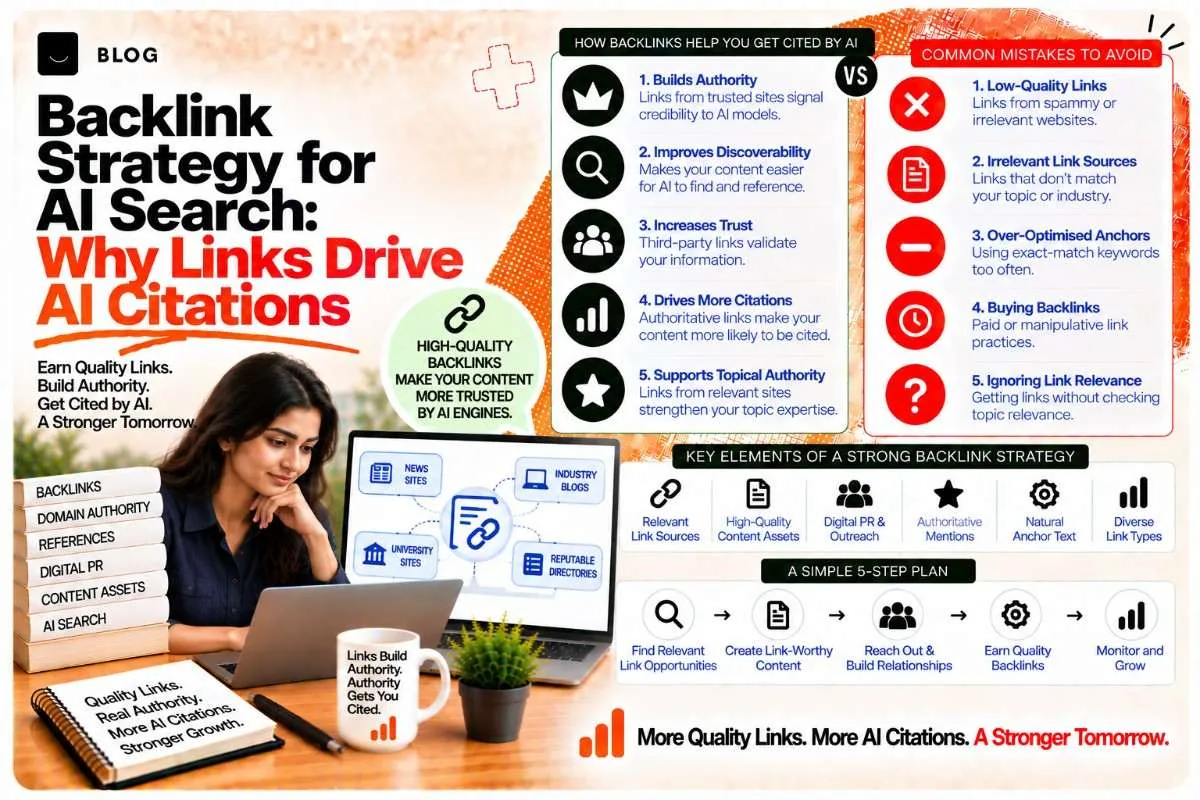
Backlink Strategy for AI Search: Why Links Drive AI Citations
A common misconception in the AI search era: "Backlinks don't matter anymore." The reasoning goes: AI systems don't crawl the web the same way Google does, so external links aren't a signal, right?
Wrong. Backlinks matter differently in the AI era, not less. They just matter in a way that requires reframing how you think about link building.
In traditional Google ranking, a backlink is a direct ranking signal — more links + higher-quality links = higher rankings. In AI search, a backlink is a credibility signal that tells AI systems: "Other authoritative sources trust this."
This distinction changes what you should build links for and how you measure their impact.
How AI systems evaluate backlinks differently than Google's ranking algorithm
Google's algorithm uses backlinks as a ranking signal because they're correlated with authority: if many sites link to you, you're probably authoritative. The more links, the higher the ranking boost.
AI systems use backlinks as a credibility check. When ChatGPT, Perplexity, or Google's AI is assembling an answer and considering whether to cite your content, it asks: "Is this source credible?" Part of that assessment is: "How many other credible sources reference this?"
The difference is subtle but important:
Traditional ranking: More links = higher ranking (all else equal)
AI citation: Links from authoritative sources = credibility signal; links from low-authority sources = weaker signal or no signal
This means:
- A page with 20 backlinks from low-authority sites might not drive AI citations
- A page with 5 backlinks from highly authoritative sites is much more likely to be cited
- The anchor text (the linked text) matters less for AI than it does for Google ranking
- The quality and relevance of the linking page matter more
You're optimizing not for ranking boost, but for credibility and citation likelihood.
What counts as a high-quality backlink in the AI era
A high-quality backlink now is:
- From an authoritative source — a website with established credibility in your industry
- From a relevant source — the page linking to you is about a related topic (not a random sidebar link)
- In editorial context — the link is earned (naturally written into content) rather than purchased, solicited, or automated
- To relevant anchor text — the link describes what you're about, but doesn't feel keyword-stuffed
- Dofollow — the link passes authority (nofollow links have little impact)
Examples of high-quality backlinks:
- A case study or research page links to your resource
- An industry publication mentions your site in an article
- A influencer or thought leader references your content
- A university or educational institution links to your guide
- A directory or aggregator lists your business (with clean anchor text)
Examples of low-quality backlinks:
- A paid link from a low-authority site
- An automated blog commenting system that drops a link
- A sidebar link that has nothing to do with your content
- A link with keyword-stuffed anchor text (e.g., "cheap seo services near me")
- A nofollow link
Link-building strategy for AI visibility: where to focus effort
Instead of pursuing quantity, focus on these high-impact link-building strategies:
1. Create content worth linking to
The most sustainable link-building strategy is creating content so useful, unique, or authoritative that people naturally want to link to it.
Examples:
- Original research (e.g., "We surveyed 500 marketers about AI adoption")
- Comprehensive guides that become the go-to resource (e.g., "The Complete Entity SEO Playbook")
- Tools or calculators (e.g., "AI Citation Feasibility Checker")
- Case studies with real results
Strategy: Identify what gap exists in your industry (what are people searching for that no one has a definitive answer to?), create the definitive answer, then reach out to related sites and let them know it exists.
2. Reach out to industry publications and media
Publications covering your industry need sources and expert opinions. If you have insights or a unique perspective, you can earn media mentions and backlinks.
Strategy:
- Monitor industry publications and blogs
- When they cover topics you have expertise in, reach out with a perspective or data
- Offer to write a guest article
- Pitch yourself as a source for their coverage
3. Partner with complementary businesses
If your business is complementary to another business, you can link to each other in context. This works especially well for local businesses and service providers.
Example: A web development agency might link to SEO providers (recommending them for specific client needs), and the SEO provider links back.
Strategy: Reach out to 5–10 complementary businesses and propose mutual linking or referral arrangements.
4. Build relationships with industry influencers and thought leaders
Influencers and thought leaders in your industry have large platforms and high authority. A mention from them carries weight.
Strategy:
- Follow their work, engage with their content
- Share their insights and give credit
- When they publish something relevant to your work, reach out and mention it
- Offer to collaborate on content
5. Claim your listings in directories and aggregators
High-authority directories (industry-specific, local aggregators, reviews) are easy link-building wins. Many of these are free; some are paid.
High-authority directories:
- Google Business Profile (free, critical)
- Industry-specific aggregators (e.g., Crunchbase, AngelList for startups)
- Professional associations (if applicable to your industry)
- Local business directories (often free)
These links are typically nofollow, but they still support credibility and entity clarity.
6. Monitor competitor backlinks and replicate
A simpler strategy: look at where your competitors are getting links, and replicate those links.
Tools for this: Ahrefs, Semrush, Moz (all have backlink analysis).
Strategy:
- Identify your top 3 competitors
- See which sites link to them
- Assess whether those same sites would benefit from linking to you
- Reach out and explain why a link would be valuable for their audience
What NOT to do: link-building tactics that backfire
Don't buy links.
Google explicitly penalizes paid links, and AI systems weight paid links as low-credibility signals. Bought links are worth less than earned links.
Don't use link-building services.
Most link-building services place links on low-authority sites or use automated/spammy methods. These hurt more than they help.
Don't use keyword-stuffed anchor text.
Linking with anchor text like "best cheap seo services in [city]" looks like link spam. Use natural anchor text (your brand name, a descriptive phrase, or just link to the page's title).
Don't pursue quantity over quality.
100 links from low-authority sites are worth less than 10 links from high-authority sites. Focus on quality.
Don't ignore broken backlinks.
When you discover that a site linking to you has changed their content or removed the link, reach out and ask them to link again, or adjust your internal link to the page they're linking to.
Link building as a long-term strategy
Effective link building takes time. Unlike ranking improvements (which can take months) or content updates (which can be fast), building a credible backlink profile takes 6–12 months to show results.
Timeline expectations:
- Months 1–2: Research, relationship-building, pitch outreach
- Months 2–4: Links start coming in from your outreach
- Months 4–6: Secondary effects (sites discover your content through referrals, start linking)
- Months 6–12: Cumulative effect (more links attract more links; your site becomes a known resource)
- 12+ months: Authority compounds
Measuring link-building impact on AI visibility
Unlike traditional ranking, which you can measure in search position, AI citation is harder to measure. But you can track:
- Mentions in AI search results — run your key topics through ChatGPT, Perplexity, Google AI weekly and note whether you're cited
- Referral traffic from AI sources — set up a UTM tag or track traffic source in GA4 to identify clicks from AI systems
- Backlink growth — track your domain's backlink count using Ahrefs or Semrush; aim for 5–10 new high-quality links per month
- Brand mentions — monitor for unlinked mentions of your brand and reach out to ask for a link
Frequently asked questions
Yes. Google still uses backlinks as a ranking signal. But the way backlinks are used has evolved: quality over quantity is more important than ever, and Google is better at detecting and penalizing low-quality or spammy links.
Both. A page with great content but no backlinks might never be found. A page with mediocre content and many backlinks might rank but not convert. Build both: excellent content + credible backlinks.
It depends on the keyword and competition. Competitive keywords (e.g., "SEO services") might require 50–100+ quality backlinks. Less competitive keywords (e.g., "SEO services in Bhopal") might rank with 5–20. Focus on relevance and authority, not quantity.
Dofollow links pass authority and should be your primary target. But nofollow links still help with credibility, brand mentions, and referral traffic. Accept nofollow links if they come naturally, but don't spend effort chasing them.
No. Self-linking (creating fake websites to link to yours) is obvious link spam and will hurt you. Only count links from other websites.
Ongoing. Link building is a continuous process. Aim for 1–2 outreach pitches per week, with the goal of landing 1–2 new quality links per month. Consistency matters more than bursts of activity.
Ready to build what's next?
Tell us where you're headed. We'll come back with a plan to get there.
Book an intro call