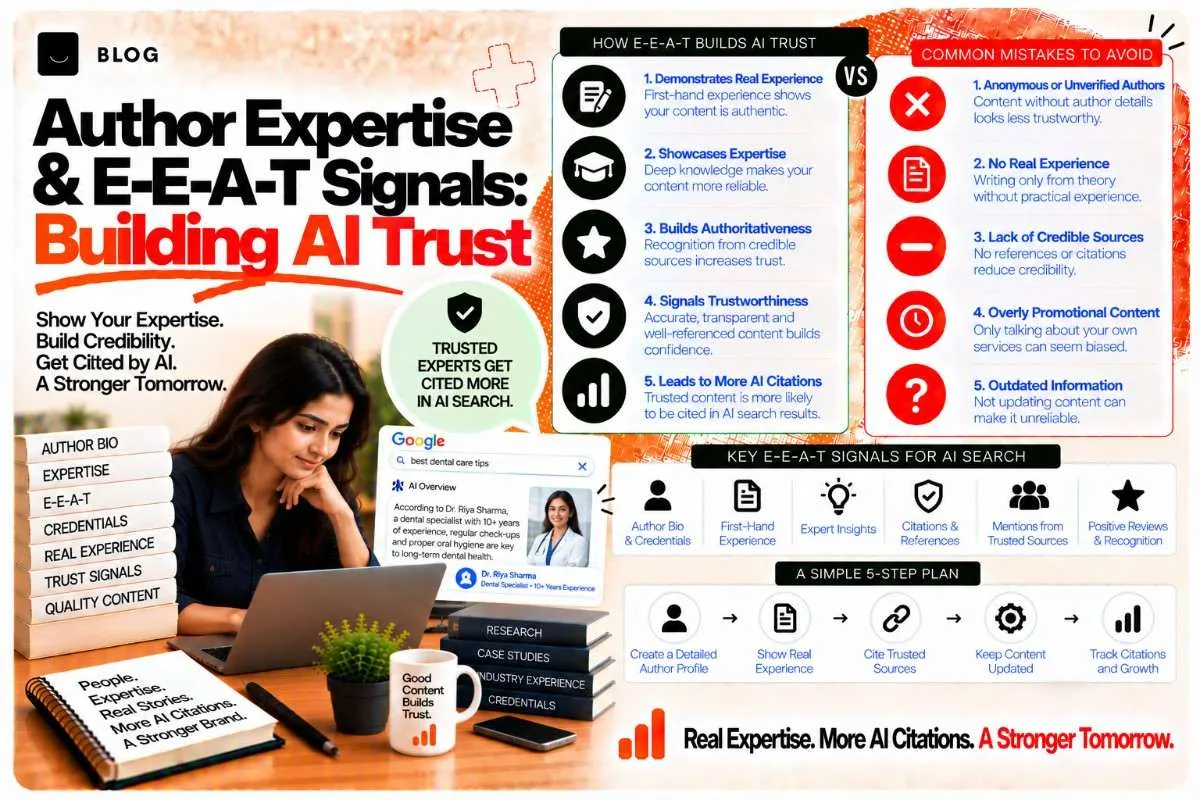
Author Expertise & E-E-A-T Signals: Building AI Trust
Google has talked about E-E-A-T (Experience, Expertise, Authoritativeness, Trustworthiness) for years. But the meaning has shifted. It's no longer just about content quality; it's about the person or organization behind the content.
When AI systems (ChatGPT, Perplexity, Google's AI) are deciding whether to cite your content, they're not just reading words. They're asking: "Who wrote this? What are their credentials? Are they an expert in this field? Should I trust them?"
This is where author expertise and E-E-A-T signals come in. A blog post about SEO written by someone with 10 years of experience and published credentials carries more weight than the same post written by an anonymous author. AI systems recognize the difference.
Building E-E-A-T through author signals is now a core SEO and AI visibility strategy.
What E-E-A-T actually means for AI systems
E-E-A-T stands for:
- Experience — the author has hands-on experience in the field
- Expertise — the author has demonstrated knowledge and credentials
- Authoritativeness — the author is recognized as an authority
- Trustworthiness — the author is reliable and transparent
Traditionally, Google evaluated E-E-A-T through backlinks, brand mentions, and content signals. For AI systems, the evaluation is more direct: they look at the author explicitly.
AI systems evaluate author E-E-A-T through:
- Author bylines and bio information
- Author credentials (certifications, degrees, published work)
- Author schema markup (structured data about the author)
- Author's other published work and portfolio
- Consistency of voice and expertise across posts
- Author's social proof (LinkedIn followers, speaking engagements, media mentions)
A page that clearly attributes content to a qualified author is more likely to be cited than an anonymous post, even if the content is identical.
The author byline: making expertise visible
An author byline is the simplest E-E-A-T signal. It's the statement that tells readers: "This was written by [Name], who is a [Role] with [X years] of experience."
Where bylines appear:
- At the top of the post
- At the bottom of the post (below the content)
- In a sidebar or dedicated author section
- In the page schema (Author field)
What a strong byline includes:
- Author name (use real names, not brand names)
- Job title or role (e.g., "SEO Specialist," "Digital Strategist")
- Years of experience (e.g., "5+ years in SEO")
- Key credentials or certifications (if relevant)
- Link to author's website or professional profile
Example byline:
"By Abhishek Raikwar, SEO Lead at SRK University Group with 5+ years of experience in SEO, AEO, and GEO strategy. LinkedIn: linkedin.com/in/abhishekraikwar-ai-expert"
This tells AI systems (and readers) that the author is qualified, experienced, and findable.
Author bio: expanding expertise signals
An author bio is a more detailed version of the byline. It typically appears at the bottom of a post or in the author's profile.
A strong author bio includes:
- Name and headshot — a real photo builds trust (AI systems notice)
- Current role — what they do now
- Background — previous roles, years of experience
- Expertise areas — specific skills and specialties
- Social proof — LinkedIn, speaking engagements, publications
- Links — to their professional profiles
Example author bio:
"Abhishek Raikwar is the SEO Lead at SRK University Group, managing a team of 4 SEO specialists. With 5+ years in digital marketing and SEO, he specializes in AEO (Answer Engine Optimization), GEO (Generative Engine Optimization), and local SEO strategy. He previously led the SEO team at Good4Scale (Solar4Good, Chilink Australia) and holds an MBA in Marketing & Business Analytics. Connect on LinkedIn or follow @talkaiwithabhi on Instagram."
This signals expertise at multiple levels: professional role, experience, education, and social proof.
Author schema markup: structured E-E-A-T
Author schema markup is structured data that tells search engines and AI systems about the author of a piece of content. It's the most direct way to signal E-E-A-T.
Add author schema to your page's <head> section:
{ "@context": "https://schema.org", "@type": "Article", "author": { "@type": "Person", "name": "Abhishek Raikwar", "url": "https://linkedin.com/in/abhishekraikwar-ai-expert", "sameAs": [ "https://twitter.com/talkaiwithabhi", "https://instagram.com/talkaiwithabhi" ], "jobTitle": "SEO Lead", "workLocation": "Bhopal, India", "knowsAbout": [ "SEO", "AEO", "GEO", "Entity SEO", "AI Search" ], "educationDetails": { "@type": "EducationalOccupationalCredential", "credentialCategory": "MBA Marketing & Business Analytics", "issuedBy": "Jagran Lakecity University" } }, "datePublished": "2026-10-12", "dateModified": "2026-10-12", "publisher": { "@type": "Organization", "name": "Digital4Local", "url": "https://digital4local.com" } }
Key fields:
- name — author's full name
- url — link to author's website or professional profile
- sameAs — links to other profiles (Twitter, LinkedIn, Instagram)
- jobTitle — current role
- workLocation — where the author works
- knowsAbout — areas of expertise (use controlled vocabulary when possible)
- educationDetails — degrees, certifications, credentials
- hasCredential — for professional certifications (CPA, lawyer, doctor, etc.)
This schema tells AI systems exactly who the author is and what they're qualified to speak about.
Building author authority across multiple posts
E-E-A-T is strongest when an author publishes consistently on their area of expertise. Publishing one post on SEO doesn't establish expertise; publishing 20 posts on SEO does.
Strategy for building author authority:
- Publish consistently in one topic area — become the go-to expert on a specific topic
- Link between your posts — let readers and AI systems see that you've written extensively
- Update and expand old posts — show that you're continuing to develop expertise
- Publish outside your site — contribute to industry publications, speak at conferences, get quoted in media
- Build your author profile — maintain an updated LinkedIn, website bio, and professional presence
Example:
If you're building authority in "Entity SEO," publish:
- Post 1: "What is Entity SEO?"
- Post 2: "Entity SEO Playbook"
- Post 3: "NAP Consistency for Entity Authority"
- Post 4: "Author Expertise and E-E-A-T"
Then link between them. AI systems see that you've written 4 posts on entity SEO and conclude you're an expert.
Author expertise for different content types
Blog posts and articles:
Use author bylines + author schema. Include biography at the end.
News and timely content:
Author byline is critical. News aggregators and AI systems heavily weight author credibility.
Product reviews and comparisons:
Byline + bio + disclosure of experience with products. Mention how long you've been reviewing products.
Educational content and guides:
Author credentials are essential. Mention degrees, certifications, years of teaching/training experience.
Opinion pieces:
Author bio + disclosure of relevant interests. Build author authority over time.
Expert interviews and Q&A:
Clearly identify the expert being interviewed. Include their credentials, company, and role.
Common E-E-A-T mistakes to avoid
Don't publish anonymously.
Anonymous posts get lower E-E-A-T scores from both Google and AI systems. Always use a real author name.
Don't let bylines go stale.
Update author bios and credentials regularly. A byline saying "5+ years of experience" written in 2020 is outdated in 2026.
Don't separate author from expertise.
If someone writes about SEO, make sure their bio mentions SEO experience. Mismatches hurt credibility.
Don't forget about author schema.
Bylines are good; schema is better. Use both.
Don't ignore consistency.
If you publish 5 posts on SEO and then 10 on unrelated topics, your authority in SEO dilutes. Stay focused.
Don't exaggerate credentials.
Claims about expertise should be verifiable. If you say you have 10 years of experience, be ready to prove it.
Frequently asked questions
Yes, indirectly. Authorship is a signal of E-E-A-T, which is a ranking factor. A post by a credible author will outrank an identical post by an unknown author.
Significantly. AI systems explicitly look at author credentials when deciding whether to cite content. A post by an author with known expertise is more likely to be cited than an anonymous post.
Build your authority over time through consistent, high-quality publishing. Years of published work can substitute for formal credentials. Transparency about your experience is also important.
One author can write multiple posts. In fact, this builds author authority. If you have a team, different authors can cover different topics, but each should have clear expertise in their area.
Author markup identifies the person who wrote the content. Organization markup identifies the company or brand. Use both: the author wrote it, and the organization published it.
Not necessarily. Demonstrated experience, published work, and public recognition can be as valuable as formal credentials. But formal credentials, when you have them, should be mentioned.
Ready to build what's next?
Tell us where you're headed. We'll come back with a plan to get there.
Book an intro call