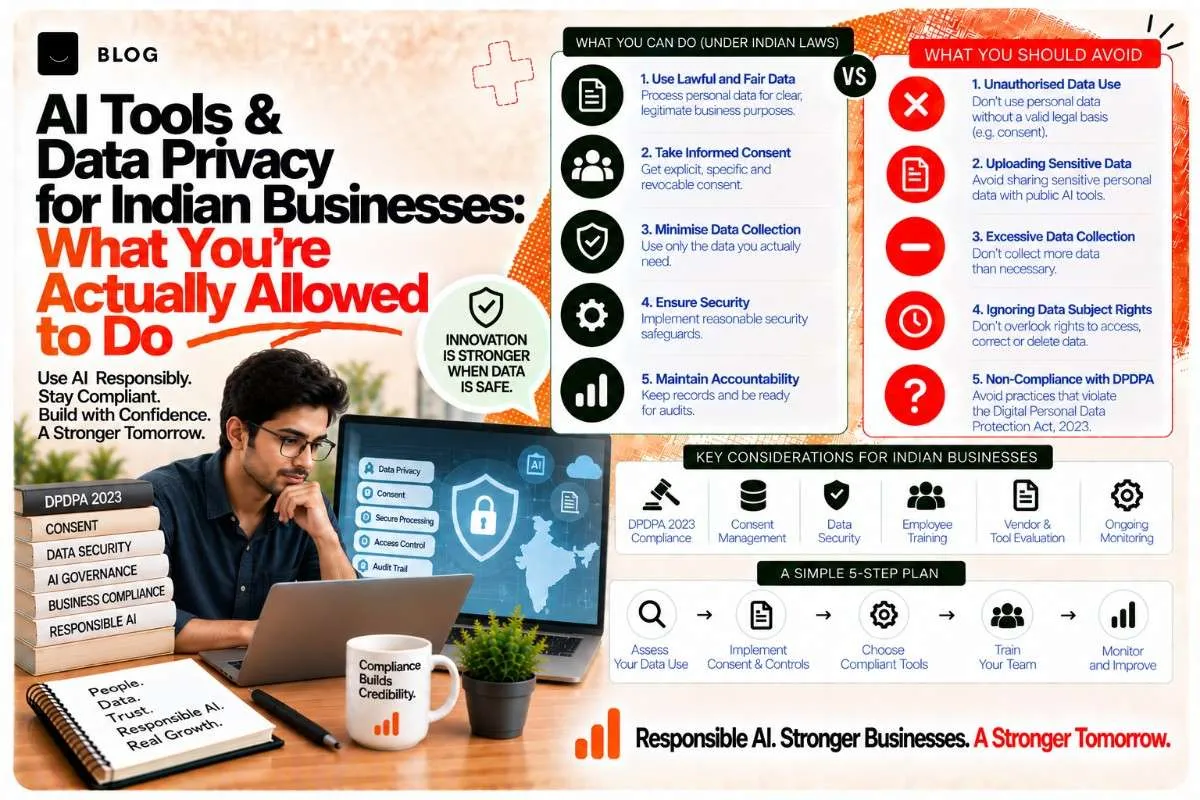
AI Tools & Data Privacy for Indian Businesses: What You're Actually Allowed to Do
A customer service team in Bangalore uses ChatGPT to draft responses. A marketing agency in Mumbai pastes competitor research and client names into Perplexity. A medical practice in Pune experiments with an AI chatbot to field appointment questions. All three are making a choice about where their data goes — and most of them don't know it.
The regulations around AI tool use in India aren't as strict as Europe's, but they're not non-existent either. Putting customer data, client information, or patient details into a commercial AI tool comes with legal friction, data residency expectations, and compliance responsibilities that surprise a lot of Indian businesses the first time they check.
This guide breaks down what's actually required, what's simply smart practice, and what happens when you get it wrong.
The regulatory landscape for AI and data in India (what actually applies)
India doesn't have a single, unified AI law in the way the EU has GDPR. Instead, there are overlapping frameworks depending on what sector you're in and what type of data you're handling.
Digital Personal Data Protection Act (DPDP), 2023 — this is the closest thing India has to a general data-privacy framework. It applies to anyone processing personal data of Indian residents, online or offline. The key trigger: if customer information (names, emails, phone numbers, addresses, browsing data) flows through an AI tool, the DPDP applies. You're now a "data processor" or "data fiduciary," and you have legal obligations.
Sector-specific rules — if you're in healthcare, finance, or advertising, additional compliance layers kick in:
- National Medical Commission (NMC) guidelines apply if you're running a medical practice, clinic, or telehealth service. Using AI tools to process patient data or generate medical advice is explicitly restricted and requires specific safeguards.
- Reserve Bank of India (RBI) regulations apply to financial services, payment systems, and lending platforms. AI tooling around financial customer data is tightly gated.
- Advertising Standards Council of India (ASCI) rules apply to influencer marketing and brand partnerships; AI content generation must be disclosed.
Data residency expectations — there's no strict legal mandate that all data must physically live in India, but the DPDP creates practical pressure to keep sensitive personal data on Indian servers or with service providers contractually obligated to store data in India.
What this actually means: if you're running a small SaaS, e-commerce, or service business in India, the DPDP is your baseline. You need to know what data you can send where, whether your AI tool vendor has a data-processing agreement with you, and whether customer data is being used to train the vendor's model.
What you can't do without legal friction (even if it seems harmless)
Dump customer names and contact info into ChatGPT for bulk processing
Even if your only intent is "create personalized email templates," you've now sent personal data to an American platform with international data residency. If a customer notices their data in your chat logs (which can happen via data breaches or security audits), you'll need to explain:
- Why you sent their data outside India
- What the customer's explicit consent was
- Whether there's a data-processing agreement in place
The DPDP requires documented, informed consent before processing personal data through a third party, especially one in a different jurisdiction.
Use AI tools to store or process patient information
The NMC's stance is clear: patient information should not be processed through general-purpose AI tools without explicit safeguards and informed patient consent. A chatbot that fields appointment requests using ChatGPT's backend is legally risky. A practice using AI for "draft summary notes" on patient data has crossed into potentially non-compliant territory.
This applies even to seemingly non-sensitive data like "which appointment slots are available" — because the appointment system connects to patient records, and the NMC's view is that patient-connected data should stay in controlled environments.
Use AI-generated content in advertising without disclosure
If you use ChatGPT or similar tools to generate ad copy, social media content, or influencer-partnership materials, ASCI guidelines require you to disclose that AI was involved in creation. Failing to disclose can result in ad takedowns and fines.
Train your own models or fine-tune AI tools on customer data
This is surprisingly common: a business tries to fine-tune a large language model on their own customer database to create a custom model. The DPDP explicitly requires opt-in consent from every data subject (customer) before their data is used for model training. Most businesses haven't asked, which is a compliance problem.
What you can do safely (with proper documentation)
Use AI tools with a data-processing agreement in place
If you have a signed Data Processing Agreement (DPA) with your AI tool vendor (ChatGPT for Business, enterprise Perplexity, etc.), you can use the tool for many business tasks, as long as:
- You've documented consent from your customer or client
- The data doesn't include health, financial, or other sensitive personal information
- You're not using the platform to train the vendor's model
- You're compliant with the vendor's own terms (most commercial AI tools explicitly ban patient/financial data)
This is the legitimate path forward for many small businesses: upgrade to a paid, business-tier AI tool that offers a DPA, document your compliance, and proceed.
Process data through vendor tools with vendor responsibility
If you use a CRM, email platform, or accounting software that has built-in AI capabilities (like Salesforce with Einstein, HubSpot with generative AI, or Zoho with Zia), those vendors have already built compliance into their stack. They're responsible for data residency, consent, and DPDP compliance. You still need to ensure your own consent collection, but the vendor shoulders regulatory responsibility for the tooling itself.
Use AI for public-facing, non-personal tasks
Drafting blog posts, creating marketing strategy documents, brainstorming product ideas, writing code snippets, analyzing industry trends — none of this involves personal data, so the privacy restrictions don't apply. An AI tool used purely for creative or strategic work doesn't trigger DPDP concerns.
Implement an internal policy around customer data and AI tools
Document a clear rule: "Customer data does not enter any consumer AI tool. Period." Make it a line item in your onboarding for new employees. This is the safest posture and the easiest to defend if audited.
A sector-specific checklist
Healthcare and Medical Practices
- Do not use ChatGPT or Perplexity to process, summarize, or draft responses about patient data.
- Any AI tool use must go through a HIPAA-equivalent agreement (India doesn't have exact HIPAA equivalent, but the NMC guidelines are closer).
- Inform patients if any clinical data touches any technology system, including AI.
- Store all patient data on Indian servers unless your patient has given explicit written consent for international transfer.
Financial Services and Fintech
- Check with your RBI compliance officer before using any external AI tool on customer financial data.
- Most consumer AI tools explicitly prohibit financial-data processing in their terms.
- Use only RBI-approved fintech tools or vendor-provided AI within your banking/payment stack.
E-Commerce, SaaS, and General Business Services
- Collect explicit consent from customers before their data enters any third-party AI tool.
- Use a business-tier AI tool with a DPA (ChatGPT for Business, etc.) rather than free tools.
- Document your AI-tool usage in your privacy policy and data-handling procedures.
- Don't fine-tune models or export customer data for AI training without explicit, opt-in consent.
Marketing Agencies and Influencer-Focused Businesses
- Disclose AI content creation in all ads and influencer partnerships per ASCI rules.
- Document that you have the right to use client/campaign data in any AI tool before doing so.
- Don't store client campaign data in consumer AI tools; use agency-specific marketing AI platforms instead.
The reputational angle (why compliance matters beyond legal risk)
Even if Indian regulators are slower to audit than European authorities, your customers and clients care. A data breach tied to an AI tool can damage trust in a way that's hard to rebuild.
A marketing agency that accidentally exposed client campaign details via ChatGPT conversations has a reputational crisis. A health clinic that had patient data surface in an AI-training dataset loses patients. A SaaS company that wasn't transparent about where customer data goes watches churn spike.
The compliance road and the trust road point in the same direction: handle customer data carefully, document your practices, and be transparent.
Frequently asked questions
Yes, but not with customer data. Using ChatGPT for internal tasks (brainstorming, coding, content drafting) is fine. Using it to process customer information, patient data, or financial records triggers DPDP compliance and requires a data-processing agreement and documented consent.
Yes, if you're processing any personal data from Indian residents through a third-party AI tool. The size of your business doesn't matter under the DPDP — the rule applies equally to startups and enterprises.
You could face regulatory notices from the DPDP authority, ASCI (if advertising-related), or your industry regulator (NMC for healthcare, RBI for finance). The customer can also file a complaint directly. Penalties can include data-destruction orders, fines, and public censure.
Retroactive consent is legally questionable and doesn't resolve the original compliance breach. Best practice: stop immediately, notify affected customers, document what happened, and move forward with proper consent collection and compliant tooling.
Indian alternatives (like platforms built on Indian infrastructure with explicit DPDP compliance) exist but are still emerging. For now, the pragmatic approach is using a business-tier ChatGPT or similar tool with a DPA, combined with an internal policy that keeps customer data out of any AI tool.
Free ChatGPT actively uses your conversations to train its models and has no data-processing agreement. ChatGPT Business includes a DPA, doesn't retain conversations for training, and offers encryption. For any business use involving customer data, ChatGPT Business (or equivalent) is non-negotiable.
You should help clients establish a data policy first, before implementing AI tools. Advising a client to use ChatGPT on customer data without a DPA or consent is exposing them to regulatory risk.
Ready to build what's next?
Tell us where you're headed. We'll come back with a plan to get there.
Book an intro call