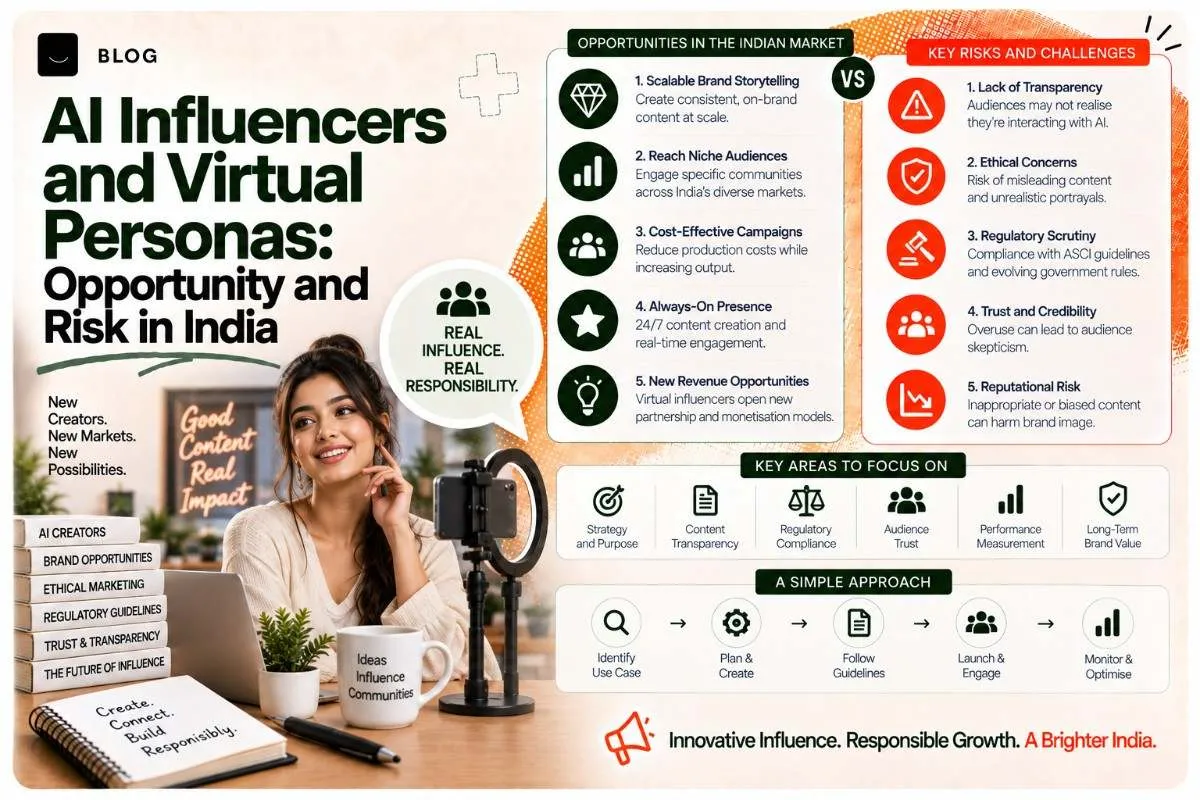
AI Influencers and Virtual Personas: Opportunity and Risk in India
A virtual influencer is a computer-generated persona — a designed character, sometimes voiced or animated with AI, sometimes fully synthetic — that posts, engages and endorses products the way a human creator does. Global brands have used them for several years; Indian campaigns are now experimenting with the format. The opportunity is real and narrow. The disclosure risk is real and currently less defined than it is for human influencers, which makes caution the right starting position rather than an obstacle to work around.
A note on what this post is and is not
This post describes the shape of the opportunity and the risk. It does not state India's current specific disclosure requirements for synthetic or AI-generated personas as settled fact, because this is an actively evolving regulatory area and any specific rule stated here risks being outdated by the time you read it.
For the disclosure rules that do apply plainly — to human creators and to any brand-commissioned content generally — see our post on building an influencer campaign that passes ASCI review. For anything specific to synthetic personas, verify directly against current ASCI guidance before running a campaign, and consider legal advice given how unsettled this specific area is.
VERIFY: This post must be checked against the current regulatory position before publishing. If ASCI or another body has issued specific guidance on synthetic or AI-generated influencers since this was written, that guidance should be linked and summarised accurately rather than left as a general caution.
What a virtual influencer actually is
Worth being precise, because the category covers genuinely different things with different risk profiles.
- A fully designed character with no claimed human identity — a brand mascot with a social media presence, clearly presented as a creation.
- An AI-voiced or AI-animated persona built to resemble and interact like a real creator, sometimes with an implied or ambiguous human identity behind it.
- A real creator using AI tools to produce content faster — not a virtual influencer at all, but often discussed in the same conversation and worth distinguishing clearly, since the disclosure question is completely different.
The risk concentrates almost entirely in the second category — personas designed to be mistaken for or read as human, where the audience may not realise no person is actually endorsing the product.
Why brands are experimenting with them
Several genuine, non-hypothetical reasons:
- Complete creative control. No scheduling around a human creator's availability, no risk of a public controversy attached to a real person, message perfectly consistent every time.
- Scalability. A virtual persona can appear in unlimited content simultaneously across markets and languages without the constraints of a single person's time.
- Novelty. Still enough of a new format that campaigns using it attract attention partly for being unusual.
- Category fit. Works better for certain categories — gaming, fashion, futuristic tech — than for others where authenticity and lived experience are central to the pitch, such as wellness or parenting content.
That last point matters: the format fits some categories naturally and fits others so poorly that using it would undermine the campaign regardless of the compliance question.
What they are genuinely good at
- Consistent brand messaging at scale, without variation risk
- Content in multiple languages or markets without coordinating multiple human creators
- Categories where the audience does not expect or require human authenticity — gaming characters, brand mascots, futuristic or fantastical product positioning
- Long-running campaigns where a consistent character is more valuable than a rotating cast of human creators
Where the risk concentrates
Disclosure ambiguity. Whether the audience understands they are engaging with a synthetic persona, not a real person, is the central question — and the honest answer is that regulatory clarity on exactly how this should be disclosed is still developing in India, more so than for standard human-influencer sponsored content, where the rules are comparatively well established.
Authenticity mismatch. A category where the entire premise of influencer marketing is "a real person genuinely uses and likes this" breaks down if the person is not real and that is not clear. This is a marketing risk independent of any regulatory one — trust, once broken on this point, is expensive to rebuild.
Reputational risk if discovery feels like deception. An audience that later learns a persona they engaged with as if it were a real person was synthetic, without having been told plainly, tends to react to that discovery badly — and the reaction attaches to the brand, not just the format.
Evolving rules. Anything built around current practice in this specific area should be built with the expectation that guidance may become more specific and more strict, not less.
The disclosure question, and why it is unsettled
Human influencer disclosure in India has reasonably well-established practice — clear labelling that content is sponsored, in specific formats, at specific points in the content. Synthetic personas complicate this in ways the existing framework was not necessarily built to address:
- Is the disclosure "this is sponsored content" sufficient, or does the audience also need to know the persona itself is not a real person?
- If a persona has an implied human identity, does that create a different or additional disclosure obligation beyond standard sponsorship labelling?
- Who is accountable if a synthetic persona makes a claim a human influencer would be prohibited from making — the brand, the agency that built the persona, or both?
None of these have a single settled answer. This is genuinely a case where the most defensible position is over-disclosure rather than minimal compliance — stating plainly that a persona is AI-generated or synthetic, even if a narrower reading of current rules might not strictly require it, because the reputational and regulatory downside of ambiguity is worse than the cost of extra clarity.
Practical questions to ask before hiring one
If a brand or agency is considering this format, these should be answered before any campaign is built, not discovered partway through:
- Does the audience know, plainly and immediately, that this is a synthetic persona? Not buried in a bio — stated where the content itself appears.
- If the persona is presented as endorsing or using the product, does that create a claim the brand cannot substantiate, in the way it would for a human reviewer?
- Who owns the persona, and what happens to past content if the brand relationship ends?
- Has current ASCI guidance on synthetic personas been checked directly, not assumed from general influencer disclosure rules?
- Does this category and audience actually suit a synthetic persona, or does the premise of the campaign depend on perceived human authenticity that a virtual persona cannot honestly provide?
Question 5 rules out more use cases than any regulatory consideration does. A skincare campaign built on "real results from a real person" simply does not work with this format, disclosure aside.
What this means for human creators
Worth addressing directly, since it is the first question most people in the industry ask about this format.
Virtual personas are not displacing human creators broadly — the format suits a narrow set of categories and campaign types, and most influencer marketing depends on exactly the human authenticity a synthetic persona cannot provide. What is genuinely changing is that AI tools are making human creators' own production faster — editing, captioning, even some scripting — which is a different and much larger shift than synthetic personas represent, and one covered elsewhere in this library.
A cautious way to test the format
For a brand genuinely curious about this:
- Start in a category where the format fits naturally — gaming, entertainment, a clearly fictional or fantastical brand world.
- Disclose plainly and immediately that the persona is synthetic, in the content itself, not only in a bio.
- Avoid any claim the persona could not honestly make — no "I tried this and it worked for me," since no one tried anything.
- Verify current guidance before every campaign, not once at the start of a relationship with the format.
- Treat the legal and compliance review as mandatory, not optional, given how unsettled this area is.
- Measure audience reaction to the disclosure itself, not just campaign performance — a negative reaction to the format is a signal worth taking seriously, separate from whether the campaign otherwise performed.
Frequently asked questions
A computer-generated character — sometimes AI-voiced or animated, sometimes a designed brand mascot — that posts and engages on social platforms the way a human creator does, and may be used to endorse or promote products. This is distinct from a real creator using AI tools to help produce their own content, which is a much more common and lower-risk practice.
Using a synthetic persona in marketing is not itself prohibited, but the disclosure obligations around it are less settled than for standard human-influencer sponsored content. Current guidance should be checked directly before running a campaign involving a synthetic persona, ideally with legal input given the lack of settled precedent.
Regulatory clarity on this specific point is still developing in India, but the safer and more defensible position is to disclose plainly, in the content itself, that a persona is AI-generated or synthetic — even where a narrower reading of existing rules might not explicitly require it. The reputational risk of ambiguity typically outweighs the cost of extra disclosure.
Consistent messaging at scale without scheduling constraints, content across multiple markets or languages without coordinating several human creators, and categories like gaming or fantastical brand worlds where audience expectation does not depend on the persona being a real person. They are poorly suited to categories relying on lived human authenticity, such as wellness or parenting content.
It depends heavily on category fit rather than cost or convenience alone. A campaign whose entire premise depends on a real person's genuine experience — "I tried this and it worked" — does not translate honestly to a synthetic persona regardless of disclosure. The format suits a narrow set of campaign types more than a general alternative to human creators.
Unlikely to broadly, based on current use. The format fits a narrow set of categories, and most influencer marketing depends on human authenticity a synthetic persona cannot provide. A larger and more widespread shift is AI tools speeding up human creators' own content production, which is a different phenomenon from synthetic personas replacing them.
Whether the audience is told plainly and immediately that the persona is synthetic, whether any implied endorsement creates a claim the brand cannot substantiate, current ASCI guidance specific to synthetic personas rather than assumed from general influencer rules, and whether the category genuinely suits the format regardless of compliance considerations.
Ready to build what's next?
Tell us where you're headed. We'll come back with a plan to get there.
Book an intro call