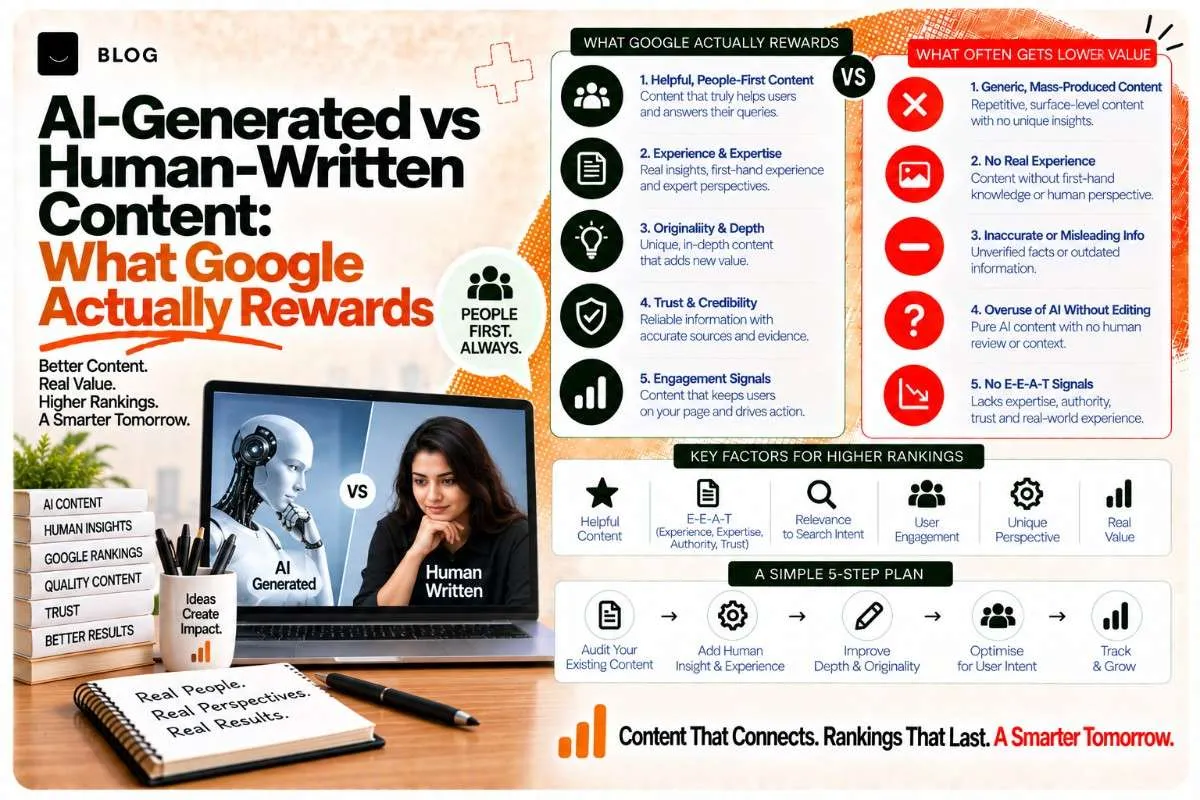
AI-Generated vs Human-Written Content: What Google Actually Rewards
Google's stated policy has been consistent: content is evaluated on whether it is genuinely helpful, not on whether AI was involved in producing it. VERIFY: confirm this framing against Google's current published guidance before publishing, since policy language is periodically revised. What actually gets penalised is unhelpful content produced at scale, regardless of whether a human or a model wrote it — and that distinction, not an "AI vs human" framing, is what should drive a content production decision.
The claim that needs correcting first
A great deal of circulating advice claims Google actively detects and penalises "AI-written" content as a category. This is not what Google's own stated guidance says, and repeating it as fact misleads a business into either avoiding AI tools entirely or assuming human authorship alone is a safeguard, neither of which is accurate.
What Google's stated policy actually says
VERIFY: The specific current wording must be confirmed before publishing. In general terms pending verification: Google's policy has focused on content quality and helpfulness as the evaluation criteria, explicitly regardless of how it was produced, while separately warning against content produced primarily to manipulate rankings rather than to help a reader — a category that includes low-effort mass-produced content whether AI-assisted or not.
What actually gets penalised
Scaled content abuse — publishing a high volume of content with little genuine value, primarily to capture search traffic. This existed as a problem before generative AI and is not new; AI tools simply made the production of such content faster and cheaper, which is why it has become more visible as a pattern.
Where AI content typically fails the helpfulness bar
Generic, unverified claims where specificity was needed. No genuine expertise or firsthand experience behind the content. Repetitive structure and phrasing across many pages that reads as templated. No named, credentialed author. Published without any human review or added value.
Where human content also fails it
Thin, rushed content produced to hit a publishing quota. Generic advice with no specific detail or firsthand experience. Content written by someone with no actual expertise in the subject, credentialed authorship notwithstanding. The failure mode is the same failure mode — the authorship method is not the variable that matters.
A workable production standard
Regardless of whether AI assists in drafting: every piece needs a named, credentialed author who reviews it. Every factual claim needs verification against a real source, not model-generated confidence. Every piece needs something genuinely specific — a real example, a real number, firsthand knowledge — that a templated page would lack. This is the same standard applied throughout this library's own content, and it is the standard that determines helpfulness regardless of how the first draft was produced.
Frequently asked questions
Google's stated policy evaluates content on helpfulness, not on the production method. What gets penalised is unhelpful, low-value content produced at scale to capture search traffic — a pattern that predates generative AI and can be produced by either humans or AI tools.
Yes, when it meets the same helpfulness standard as any other content: genuine expertise, specific verified detail, and named credentialed review. Content quality determines the outcome, not whether a model was involved in drafting.
Publishing a high volume of low-value content primarily to capture search traffic rather than to genuinely help a reader. This is the pattern Google's policy targets, and it applies regardless of whether the content was AI-assisted or entirely human-written.
No. Thin, generic, rushed human-written content produced to hit a publishing quota fails the same helpfulness bar as low-quality AI content. Authorship method is not the determining factor; genuine value and expertise are.
Ready to build what's next?
Tell us where you're headed. We'll come back with a plan to get there.
Book an intro call