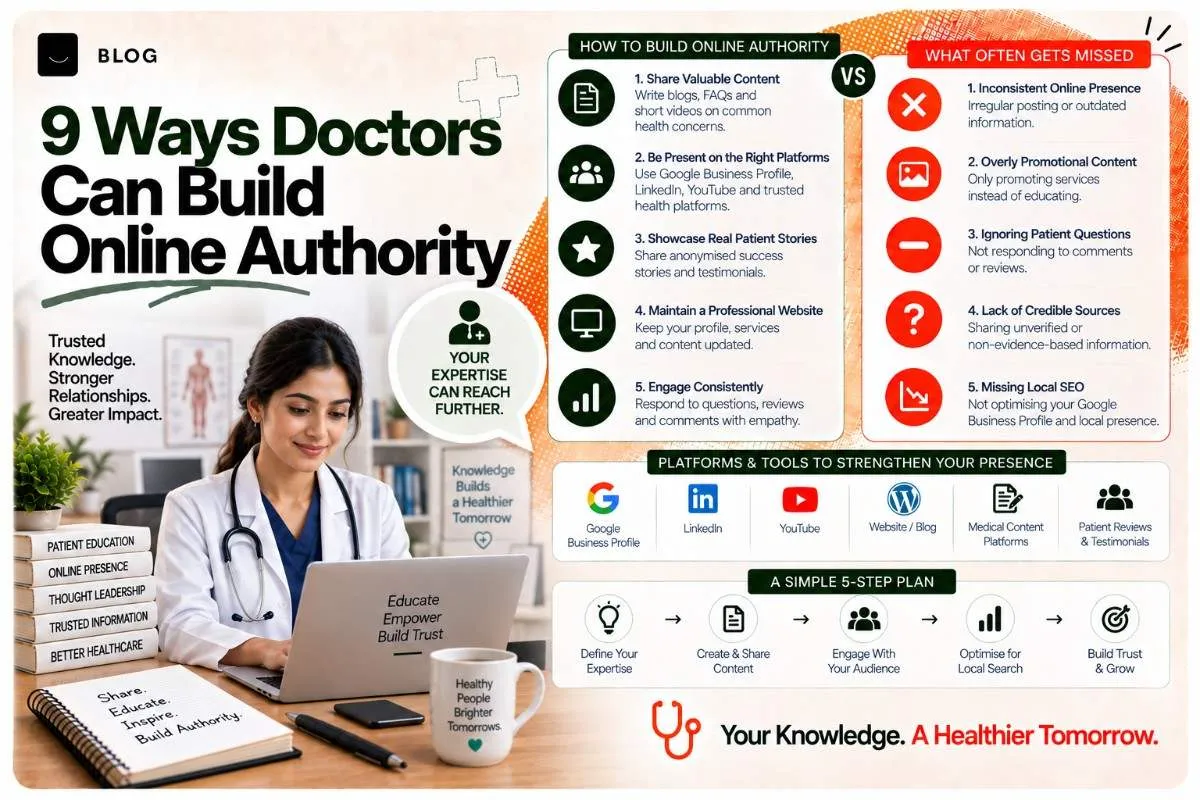
9 Ways Doctors Can Build Online Authority
Online authority for a doctor is built from the same material AI systems and patients both look for when deciding whether to trust a practitioner: credentials, genuine expertise demonstrated over time, and consistent, verifiable information. None of the nine items below is a promotional tactic. Each is a way of making real qualifications and real expertise visible and verifiable, which is a different exercise from advertising — and the distinction matters both for AI visibility and for professional conduct.
A note on scope
This post covers reputation and authority-building — bylines, credentials, professional presence. It does not cover patient communication tools, which are addressed separately, and it makes no claims about advertising or promotional tactics, since those sit under professional conduct regulations this post does not attempt to summarise.
VERIFY: Before publishing, confirm every item below against current NMC professional conduct guidance on doctor advertising and online presence. Where any item could be read as promotional rather than informational or credentialing in nature, either remove it or add an explicit caution.
Why authority is different from advertising
The distinction that organises this whole post: advertising asserts "choose me." Authority demonstrates expertise and lets a reader — human or AI system — draw their own conclusion.
A doctor claiming to be "the best cardiologist in the city" is advertising, and the claim is unverifiable and almost certainly against professional conduct rules. A doctor with a complete, accurate bio, a documented history of speaking at medical conferences, and genuinely educational published content is demonstrating expertise through verifiable facts. The second approach is both the compliant one and, separately, the one that actually works — AI systems and careful patients alike weigh verifiable credentials far more than unverifiable claims.
1. A real, complete professional bio
Qualifications, institution, years in practice, specific areas of focus, and any notable training — stated factually, not superlatively. Most doctor bios online are thin: a name, a specialty, sometimes a photo. A complete bio is a genuine differentiator simply by existing.
2. Bylined educational content, not promotional content
General health education, written under the doctor's own name, covering topics within their actual specialty — how a common condition generally presents, what a category of treatment generally involves, general wellness guidance. Never content responding to or advising on an individual patient's situation; always general and educational.
This is covered in more depth, including a safe drafting process, in our post on using AI for this kind of content — the discipline there (general only, clinician-reviewed, every time) applies here regardless of who or what drafts the first pass.
3. A complete, accurate Google Business Profile
Covered in full detail in our dedicated guide for doctors, but worth restating as an authority item specifically: a complete profile with accurate hours, services and attributes is one of the most concrete, verifiable authority signals available, and most practitioners have it half-finished.
4. Speaking and teaching history, documented
Conference presentations, guest lectures, teaching roles, panel appearances — listed with dates and institutions, not vaguely referenced. This is exactly the kind of specific, verifiable fact that distinguishes genuine expertise from a claim of expertise, and it is rarely documented anywhere on a doctor's own site.
5. Published research or case discussion, where appropriate
For practitioners with a research or academic component to their work, published papers, journal contributions or case discussions, cited properly and linked to the original source. Genuinely authoritative, genuinely verifiable, and genuinely underused as an online asset.
6. A genuine LinkedIn presence
Not promotional posts about the practice — professional commentary on genuinely interesting developments in the specialty, written in the practitioner's own voice. A doctor who occasionally shares real professional insight builds more credibility over a year than one who never posts, and considerably more than one who posts only practice announcements.
VERIFY: Confirm current professional guidance on physician social media presence before publishing this section.
7. Professional association and hospital affiliations, stated
Membership in relevant medical associations, hospital or clinic affiliations, board certifications where applicable — stated factually and verifiably. These are exactly the kind of institutional corroboration that both patients and AI systems weigh heavily, because they are checkable against an external source rather than self-asserted.
8. Answering the questions patients actually ask, generally
A well-built FAQ page covering the general questions a practice fields constantly — not advice for a specific patient, but the genuinely common questions any patient in that specialty might reasonably ask, answered clearly and factually, with an appropriate general-information disclaimer.
9. Consistency, sustained over time
The single most underrated item on this list. A complete bio published once and a LinkedIn presence maintained for eighteen months is a fundamentally different signal than either done for a month and abandoned. Authority accumulates; it does not spike. A realistic, sustainable cadence beats an ambitious one that stops after six weeks.
What to avoid entirely
- Superlative or comparative claims — "best," "leading," "top" — unverifiable and typically against professional conduct rules regardless of framing
- Any content responding to an individual patient's specific situation, published or otherwise, outside a direct clinical relationship
- Patient testimonials or before-and-after content, which sits in genuinely uncertain territory depending on current regulations and should be checked before use, if used at all
- Guarantee or outcome language of any kind
- Anything that reads as solicitation rather than information — the line is not always obvious, and where there is doubt, the more conservative reading should win
Frequently asked questions
By demonstrating expertise through verifiable, factual information — a complete professional bio, documented speaking and teaching history, bylined educational content, and institutional affiliations — rather than making comparative or promotional claims. Authority is demonstrated through checkable facts; advertising asserts a conclusion the reader cannot verify.
Yes, when the content is genuinely general — applicable to any patient in that condition category rather than responding to an individual's specific situation — factually accurate, and reviewed before publication. It should never respond to or advise on a specific patient's circumstances outside a direct clinical relationship.
A genuine professional presence sharing real commentary on developments in the specialty builds credibility over time, more so than either no presence or a presence consisting only of practice promotion. Current professional guidance on physician social media use should be checked before establishing a regular posting practice
A complete, accurate professional bio; documented speaking, teaching or research history; verifiable institutional and association affiliations; and sustained consistency over time. These are weighted heavily by both patients evaluating credibility and AI systems assessing what corroborates a practitioner's expertise.
This sits in genuinely uncertain regulatory territory that varies and should be checked against current guidance before use. Documented credentials, affiliations and publication history are consistently safer and, separately, more verifiable authority signals than testimonial content.
Authority accumulates gradually rather than spiking from a single effort. A realistic, sustainable pace maintained over many months — consistent content, an updated bio, ongoing professional presence — produces a stronger result than an intensive short burst of activity that stops after a few weeks.
No, and the distinction matters both practically and for compliance. Advertising typically asserts a conclusion — that a practitioner is the best choice. Building authority demonstrates verifiable expertise through facts a reader can check, letting them draw their own conclusion, which is both the more defensible approach and the one that holds up better with careful patients and AI systems alike.
Ready to build what's next?
Tell us where you're headed. We'll come back with a plan to get there.
Book an intro call