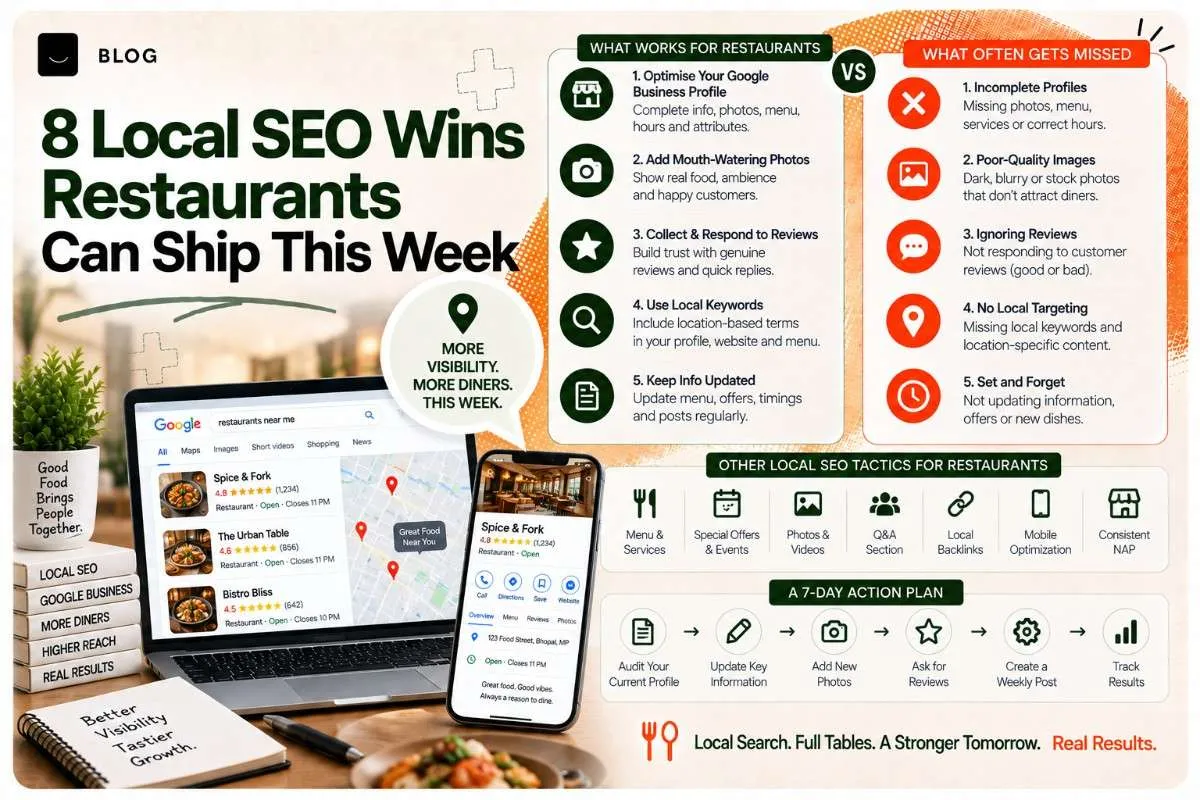
8 Local SEO Wins Restaurants Can Ship This Week
Most restaurant local SEO advice assumes time and budget a restaurant does not have. These eight fixes need neither. Each takes between fifteen minutes and two hours, none requires an agency, and together they address the things that most commonly stop a restaurant appearing when someone nearby searches for somewhere to eat — or asks an AI assistant the same question.
Start here: the ten-minute diagnostic
Before fixing anything, find out what is actually broken. On your phone:
- Search your restaurant's name and open your Google Business Profile as a customer sees it.
- Search a category term you should appear for — your cuisine plus your area.
- Ask an AI assistant where to eat near you, with a constraint a real customer would give.
Write down three things: what is wrong or missing on your profile, whether you appeared in the category search, and what the assistant said about you. Most of the eight fixes below will map directly onto what you find.
1. Fix your hours, including the ones you forgot
Time: 20 minutes. Impact: highest on this list.
Not just your regular hours — the ones that get missed:
- Different hours on different days, entered separately rather than averaged
- Separate kitchen and bar closing times, if they differ
- Festival and holiday hours, entered in advance rather than on the day
- Any weekday you are closed
Wrong hours are the most expensive error a restaurant can have online, because the cost is a customer standing outside a closed door — and that customer usually writes a review about it.
Enter special hours for the next three months now, while you are in there. Diwali, New Year and local festival dates are the ones consistently forgotten.
2. Get your menu out of the PDF
Time: 1-2 hours. Impact: high, and almost nobody does it.
A menu that exists only as a PDF or a photograph is invisible. Search engines cannot read the dishes, AI assistants cannot tell a customer whether you serve what they are asking for, and a diner on a slow connection may not open it at all.
Publish the menu as real text on a page on your website. Dish names, short descriptions, prices, and clear section headings. Keep the designed PDF as well if you like it — the two can coexist, and only one of them is readable.
This single change is what allows an assistant to answer "does this place have good vegetarian options" or "do they do Jain food" instead of hedging.
3. Fill in every attribute
Time: 30 minutes. Impact: high.
Open your profile and complete every field, not the ones that seem important:
- Dine-in, takeaway, delivery
- Reservations accepted or walk-in only
- Vegetarian, vegan and Jain options
- Alcohol served
- Outdoor seating, air conditioning, rooftop
- Wheelchair accessibility and washroom access
- Parking
- Payment methods, including UPI
- Wi-Fi
- Good for groups, families, children
- Price range
Each empty field is a question a customer or an AI system cannot get answered about you. Accessibility and dietary attributes in particular are actively searched for and almost never filled in.
4. Add the photographs that are actually missing
Time: 45 minutes. Impact: moderate to high.
Most restaurants have plenty of food photographs and none of the ones people actually need:
- The exterior, from the street, as it looks now. The most useful photograph and the most commonly missing. People navigating an unfamiliar area match what they see to what they saw online.
- The entrance, especially if it is hard to find or up a flight of stairs
- The interior, showing what the space actually feels like — not styled beyond recognition
- The seating, so a group of eight can judge whether you fit them
- Parking, if you have it
Take these on a phone, in daylight, without filters. Accuracy matters more than polish here, because the gap between the photograph and the reality is what produces disappointed reviews.
5. Reply to every review from the last three months
Time: 1 hour. Impact: moderate, compounding.
Every review, not only the bad ones. Two to three sentences each.
Reply to a positive review by naming the specific thing they mentioned and adding one detail they did not — a dish, a timing, something about the space. That added detail is new text describing your restaurant, in language a future customer and an AI assistant can both use.
Reply to a negative review briefly, without arguing, and move the detail offline. Do not write it on the same day you read it.
If the backlog is large, work backwards from the most recent and stop at three months. Consistency from here forward matters more than completeness behind you.
6. Make the phone number and booking link work
Time: 15 minutes. Impact: high, and embarrassingly common.
Call your own listed number from a phone that is not in the restaurant. Then click your own booking link.
Things that go wrong more often than owners expect: the number is an old one, it rings at a desk nobody sits at during service, it routes to a personal phone on silent, or the booking link goes to a page that no longer exists.
Also check that the number listed on your profile, your website, your delivery platform listings and your social profiles is the same number. It frequently is not.
7. Fix your name and address everywhere
Time: 1 hour. Impact: moderate, foundational.
One spelling of your restaurant's name. One address format. One phone number. Used identically on your Google Business Profile, your website, your social profiles, delivery platform listings and any directory you appear in.
Do not add descriptors to your name that are not part of the actual name. "Sharma's Kitchen" is your name; "Sharma's Kitchen — Best North Indian Restaurant in Bhopal" is not, and inflating it creates the inconsistency you are trying to remove.
Also check your map pin. Misplaced pins are common and send customers to the wrong building or the back of your own.
8. Add the one page your website is missing
Time: 1 hour. Impact: moderate, growing.
A proper FAQ page answering the questions your staff answer on the phone every day.
Do you take reservations? Is there parking? Do you have high chairs? Can you cater for a group of twenty? Do you serve Jain food? Is there a lift? What time does the kitchen close?
One question per heading, phrased the way a customer says it, with a short self-contained answer beneath each. Add FAQPage schema if your website allows it.
This matters more than it used to. With Google's crowdsourced Q&A section on business profiles replaced by AI-generated answers, your website's FAQ is now where your answers live in a form these systems can read.
What to do next week instead
Once the eight above are done, the next tier is where the compounding starts — and it is a different kind of work:
- A system for asking happy customers for reviews, run consistently
- Photographs updated seasonally rather than once
- Menu page kept current as dishes change
- Delivery platform listings matched to your own information
- Local coverage — food writers, city guides, neighbourhood publications
That last one is the slowest and the most valuable. It is also the only item on either list that depends on someone other than you.
What none of this fixes
Worth saying plainly, because local SEO advice rarely does.
- A rating problem caused by the food or the service. Profile work changes discovery, not what people think once they arrive. If ratings are falling, the fix is operational and no amount of this helps.
- Being genuinely hard to find or reach. Accurate information about a difficult location is still accurate information about a difficult location.
- A category where you are simply outnumbered. In a street with forty restaurants, complete information gets you considered, not chosen.
- Anything, instantly. Hours and attribute changes can affect what people see fairly quickly. Category visibility moves over months.
The honest framing: these eight fixes remove the reasons you are being skipped. They do not manufacture demand.
Frequently asked questions
The fastest improvements are correcting hours including festival and holiday hours, publishing the menu as readable text rather than a PDF, completing every attribute on the Google Business Profile, adding exterior and interior photographs, replying to recent reviews, and confirming the listed phone number and booking link actually work. Each takes under two hours.
Search engines and AI assistants cannot reliably read text inside a PDF or a photograph, so the dishes, prices and dietary options are effectively invisible. Publishing the menu as real text on a page allows a customer asking about vegetarian, Jain or specific dishes to get an accurate answer instead of a hedge.
Dietary options including vegetarian, vegan and Jain; service options such as dine-in, takeaway and delivery; reservation policy; accessibility including wheelchair access and washrooms; parking; payment methods including UPI; and seating details such as outdoor or rooftop. Accessibility and dietary attributes are actively searched for and rarely completed.
Yes. Future customers read the pattern of responses, and a restaurant that only appears when something goes wrong reads as defensive. Positive reviews are also the best opportunity to add factual detail about the restaurant, since the reviewer has not raised a problem that needs addressing.
The commonly missing ones matter most: the exterior from the street as it looks now, the entrance if it is hard to find, the interior showing what the space actually feels like, seating that shows group capacity, and parking. Take them on a phone in daylight without heavy filtering, because accuracy prevents disappointed reviews.
Yes, for two things the profile cannot do: hosting a readable menu, and answering the questions customers ask most often. With the crowdsourced Q&A section on business profiles replaced by AI-generated answers, a website FAQ page is now where a restaurant's answers exist in a form those systems can read.
Corrections to hours, attributes and profile information can affect what customers see fairly quickly, because that data is retrieved rather than learned. Visibility for category searches such as a cuisine plus an area moves over months. No profile work fixes a rating problem caused by the food or the service.
Ready to build what's next?
Tell us where you're headed. We'll come back with a plan to get there.
Book an intro call