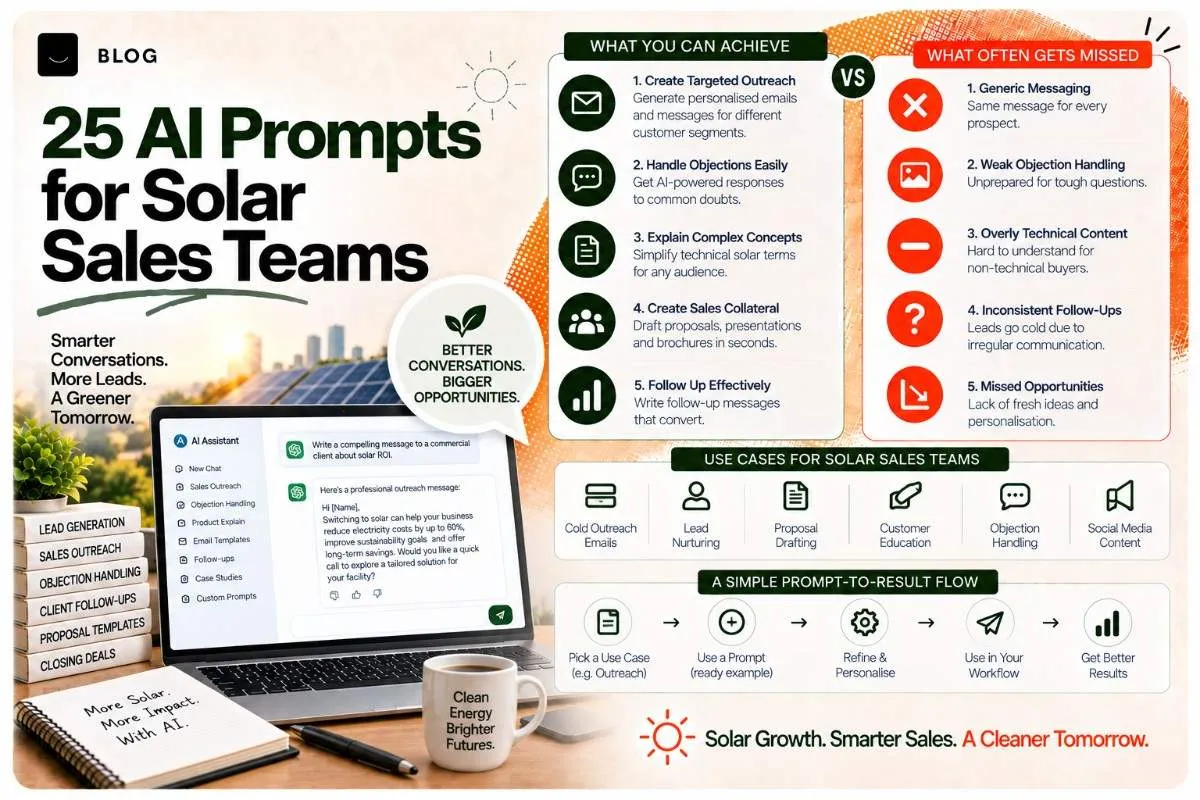
25 AI Prompts for Solar Sales Teams
A solar sales conversation runs into the same handful of objections and questions on nearly every call — price, payback period, "will it actually work on my roof," subsidy confusion, what happens if something breaks. These 25 prompts turn that recurring ground into fast, consistent drafts a salesperson can adapt in seconds rather than writing from scratch under pressure on a call. One rule governs all of them, stated once here rather than repeated twenty-five times.
The one rule that makes every prompt below safe to use
Every number, subsidy detail, warranty term and technical claim in the output must be checked against your own current, verified figures before it is said to a customer or sent in writing. AI will produce a plausible, confidently-worded answer to a question about payback periods or subsidy percentages. It has no way of knowing your actual current numbers, your specific state's scheme, or your company's actual warranty terms — it will fill those gaps with something that sounds right and may not be.
Treat every prompt below as producing a structure and a tone, not a source of facts. Paste your verified numbers into the brackets every time; never let the model supply them.
VERIFY: No specific subsidy percentage, payback timeline or pricing figure appears in this post for exactly this reason. If any example output is included when this post is adapted for internal training material, every figure in it must be replaced with current verified numbers first.
Objection handling — 7 prompts
1. "It's too expensive"
A prospective customer said solar is too expensive. Their approximate monthly electricity bill is [amount]. Write a short, non-pushy response that reframes cost as a comparison to what they already pay monthly, without stating any specific payback period or savings figure — leave those as [INSERT VERIFIED FIGURE] for me to fill in.
2. "I'll wait for prices to come down"
A prospect wants to wait for solar prices to drop further before buying. Write a brief, respectful response addressing the trade-off between waiting and the [ELECTRICITY COST INCREASE TREND — insert your verified regional data] they'd pay in the meantime. Do not state a specific percentage or number — flag where I need to insert one.
3. "Will it actually work on my roof?"
A customer is unsure whether their roof suits solar. Write a short explanation of the factors that actually determine suitability — orientation, shading, roof condition, available area — without claiming their specific roof works, since that requires an actual site assessment.
4. "What if a panel breaks or underperforms?"
Write a plain-language response to a customer worried about equipment failure, covering what a warranty typically protects against in general terms. Insert [OUR ACTUAL WARRANTY TERMS] as a placeholder — do not state specific warranty length or coverage.
5. "I've heard installers disappear after the sale"
A prospect is worried about installer reliability based on bad experiences in the market. Write a response that addresses this concern honestly without disparaging competitors by name, focusing on what a customer should reasonably expect and verify from any installer.
6. "The subsidy process seems too complicated"
Write a reassuring but honest response to a customer intimidated by subsidy paperwork, explaining in general terms that this is a common concern and how a good installer typically supports the process. Do not state specific subsidy amounts, eligibility criteria or scheme names — flag these as [INSERT CURRENT VERIFIED SCHEME DETAILS].
7. "I want to compare more quotes first"
A prospect wants to shop around before deciding. Write a brief response that supports their instinct to compare rather than pressuring them, and suggests three specific, fair things to compare across quotes (equipment specifications, warranty terms, and installer track record).
Savings and technical explainers — 6 prompts
8. Net metering, explained simply
Explain net metering in plain language for a customer with no technical background, in under 150 words. Do not state a specific state's process as universal — note that it varies by state and [INSERT STATE-SPECIFIC VERIFIED PROCESS] where relevant.
9. How panel degradation works
Explain how solar panel output changes over its lifespan, in plain language, without stating a specific degradation percentage — flag [INSERT VERIFIED MANUFACTURER SPEC] for me to complete.
10. On-grid vs off-grid vs hybrid
Write a short, clear comparison of on-grid, off-grid and hybrid solar systems for a residential customer deciding between them, covering what each is actually for rather than which is "better."
11. What affects system size and cost
List the main factors that determine solar system size and cost for a residential customer — roof area, energy consumption, budget, local regulations — in a short explainer with no specific pricing stated.
12. Maintenance expectations
Write a realistic, honest explanation of what solar panel maintenance actually involves for a residential customer, avoiding both "maintenance-free" oversell and unnecessary alarm.
13. What happens on a cloudy or rainy day
Explain in plain language how solar panels perform in cloudy or low-light conditions, addressing this common misconception honestly without overstating output in poor conditions.
Follow-up and nurture — 6 prompts
14. Post-consultation follow-up
Write a brief, warm follow-up message for a prospect who had a consultation but has not responded in [X days]. Reference [SPECIFIC DETAIL FROM THEIR CONSULTATION] without being pushy, and offer one clear next step.
15. Re-engaging a "not now" lead
Write a light-touch check-in message for a prospect who said "not right now" [X months] ago. Reference something relevant that may have changed (season, electricity rates, subsidy timing) without pressure.
16. After sending a quote
Write a short follow-up for a customer who received a quote [X days] ago and has not responded, inviting questions rather than pushing for a decision.
17. Referral request from a satisfied customer
Write a brief, genuine-sounding message asking a recently satisfied customer whether they know anyone else who might benefit from solar, without sounding transactional.
18. Seasonal re-engagement
Write a short seasonal message to past leads noting [SPECIFIC SEASONAL RELEVANCE — e.g. summer electricity bill rises] as a reason to reconsider, factually rather than urgently.
19. Addressing a long silence
Write a brief, low-pressure final follow-up for a lead who has gone silent for [X weeks], giving them an easy way to say no or an easy way to pick the conversation back up.
Proposal and quote support — 4 prompts
20. Structuring a proposal summary
Structure a clear proposal summary for a residential solar customer covering system size, key equipment, estimated timeline and what happens at each stage. Leave [ALL FIGURES] as placeholders for verified data.
21. Explaining a quote line by line
Write a plain-language explanation of what each line item in a typical solar quote covers (equipment, installation, permits, etc.), to help a customer understand what they are paying for, without stating specific costs.
22. Comparing package options
Write a clear, neutral comparison of [OUR PACKAGE OPTIONS — insert details] to help a customer choose, without pushing toward the most expensive option.
23. Explaining financing options
Write a plain-language overview of financing options generally available for solar installations, noting that specific terms depend on the provider and [INSERT CURRENT VERIFIED FINANCING PARTNERS AND TERMS].
Internal team use — 2 prompts
24. Structuring call notes into a CRM entry
Turn these rough call notes into a structured CRM entry with sections for objections raised, next steps, and follow-up timing: [PASTE ROUGH NOTES]
25. Weekly objection pattern summary
I'm pasting a week's worth of sales call notes. Identify the three most common objections or questions raised, so the team can prepare better responses: [PASTE NOTES]
What these prompts are not for
- Generating any figure a customer will see or hear — price, payback period, subsidy amount, warranty term. Every one of those comes from your verified current data, never from the model.
- Replacing an actual site assessment. No prompt here determines whether a specific roof suits solar; that requires someone looking at the roof.
- Final customer-facing copy without a read-through. These are drafts. A person reads every output before it reaches a customer, checking specifically for any number or claim that needs replacing.
- Legal or contractual language. Anything touching a formal agreement needs your actual contract terms, not a drafted approximation.
Frequently asked questions
Yes, for structure and tone — objection responses, follow-up messages, explainer copy. It should never be trusted to supply specific figures like pricing, subsidy amounts, payback periods or warranty terms, since it has no way of knowing a company's actual current numbers and will produce a plausible but potentially incorrect figure if asked.
Unverified numbers reaching a customer. A model will confidently state a subsidy percentage, payback period or warranty term that sounds reasonable and may be wrong or outdated. Every prompt should be structured so figures are inserted by a person from current verified data, never generated by the AI itself.
As a starting point for structure and tone, adapted every time with the team's own verified figures and specific customer context. The value is in producing a fast, consistent first draft under time pressure — on a call or in a follow-up — not in producing finished, unchecked customer communication.
It can draft a plain-language explanation of concepts like net metering, panel degradation or system sizing, which is useful for training and for adapting into customer conversations. Any specific number within that explanation — a degradation rate, a state's net metering process — should be verified and inserted by the team rather than generated by the model.
No. Every draft should be reviewed for tone, accuracy and relevance to the specific prospect before sending. A generic-sounding follow-up, even a technically accurate one, performs worse than one edited to reference something specific about that actual conversation.
The structure and the verification discipline transfer directly to wind, battery storage or other renewable sales conversations. The specific objections and technical explainers would need adapting to the relevant technology, but the underlying pattern — objection handling, savings explainers, follow-up, proposal support — applies broadly.
Ready to build what's next?
Tell us where you're headed. We'll come back with a plan to get there.
Book an intro call