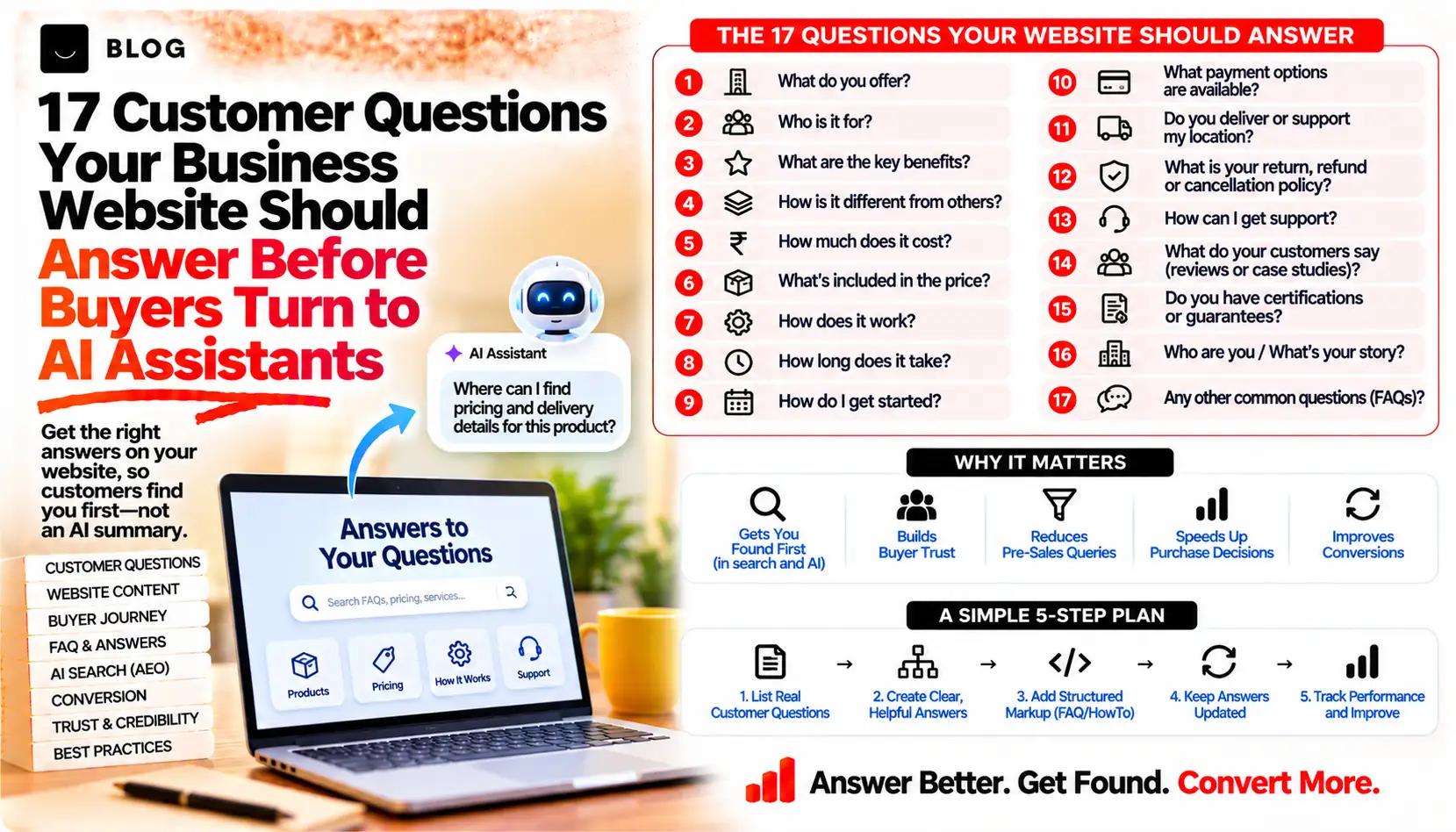
17 Customer Questions Your Business Website Should Answer Before Buyers Turn to AI Assistants
A buyer shopping for a service rarely begins with your name. They begin with a question: how much does this cost, how long will it take, can I trust them, do they cover my area. Not long ago they typed fragments into Google and scanned ten links. Now many type the whole question into ChatGPT, Gemini or Perplexity and read one composed answer.
That answer is built from pages that state things clearly. If your website answers a question in specific terms, you give both people and AI systems something accurate to use. If it answers vaguely, or not at all, someone else's page fills the gap, or the assistant fills it with a guess.
This article lists 17 questions that almost every service business should be able to answer on its website, grouped into five themes. For each one, it explains what a good answer contains and where it belongs. It also covers how to find the questions unique to your business and the mistakes that turn useful answers into thin pages.
What question-led content can and cannot do
Answering real questions makes your site more useful to buyers, reduces repetitive sales calls and gives assistants clear material to draw on. It also helps you spot gaps in how you describe your own services.
It cannot guarantee an assistant will quote or recommend you. Google's guide to generative AI features says that unique, helpful content matters most for visibility there, and that content which only restates common knowledge adds little. It also warns that creating separate pages for every possible variation of a question, mainly to influence rankings or AI responses, runs against its scaled content abuse spam policy. So the goal is not more pages. It is better answers, placed on the pages where a buyer would expect to find them, written from your own experience.
Theme 1: Understanding what you do
1. What exactly do you do, and who is it for?
A good answer includes: The service in plain words, the type of customer you work with, the typical problem you solve and one clear example. Name the service itself, not a slogan.
Where it belongs: The top of the homepage and the top of each service page.
2. Is this the right service for my situation?
A good answer includes: Who the service suits, who it does not, and what the buyer should consider instead if they are not a fit. Saying "this is not for you if..." builds more trust than claiming to suit everyone.
Where it belongs: A short "Is this right for you?" section on each service page.
3. How is your approach different from other providers?
A good answer includes: Specific differences a buyer can verify, such as your method, qualifications, team structure or what is included as standard. Avoid superlatives you cannot back up.
Where it belongs: The service page and the About page. A short comparison page can work if buyers genuinely ask for it.
Theme 2: Cost and commitment
4. How much does it cost?
A good answer includes: A price, a range or a starting figure, with what it covers. If you cannot publish prices, say why and give a realistic band so the buyer can judge whether to enquire.
Where it belongs: A pricing section on each service page, or a dedicated pricing page.
5. What affects the price?
A good answer includes: The three to five factors that move the cost, such as size, complexity, location, urgency or materials. This helps buyers estimate their own case and shows how you think.
Where it belongs: Directly beneath the pricing information.
6. How long does it take?
A good answer includes: A typical timeline from first contact to completion, the stages in between and what can cause delays.
Where it belongs: The service page and the process section described in question 12.
7. What are the payment terms, contract length and cancellation rules?
A good answer includes: Deposits, payment schedule, minimum commitment, notice period and refund conditions, written in plain language rather than legal text.
Where it belongs: A terms summary linked from service pages, with the full terms on a separate page.
Theme 3: Trust and proof
8. Are you qualified, licensed or insured?
A good answer includes: The relevant registrations, licences, memberships or insurance, with registration numbers or verification links where the rules allow. Only list credentials you hold and can document.
Where it belongs: The About page, the footer for core credentials and any service page where a credential is required by law or custom.
9. Who will actually do the work?
A good answer includes: Names, roles, experience and a real photo of the people who deliver the service, plus how work is supervised.
Where it belongs: A team page, with a short profile or link on each service page.
10. Can I see examples, reviews or references?
A good answer includes: Real projects or case studies with dates and permission from the client, and reviews that name the service provided. Do not publish numbers you cannot trace to a real project.
Where it belongs: A results or projects page, with relevant examples placed on each service page.
11. What happens if something goes wrong?
A good answer includes: Your guarantee, complaint process, revision policy or insurance cover, and how quickly you respond to problems.
Where it belongs: The service page and the terms summary.
Theme 4: How you work
12. What happens after I get in touch?
A good answer includes: The steps from enquiry to delivery, what each stage involves and how long each takes. A numbered list works well here.
Where it belongs: A "How it works" section on the homepage and each service page.
13. What do you need from me?
A good answer includes: Information, documents, access, decisions and time the customer must provide, and when.
Where it belongs: The process section, or a short "Before we start" list.
14. Do you work in my area?
A good answer includes: The towns, regions or countries you serve, whether you travel or work remotely, and any extra charges outside your core area. State only areas you genuinely serve.
Where it belongs: The Contact page, the footer and each location page if you have genuine local presence there.
Theme 5: Practical details and decision support
15. How do I contact you, and how fast will you reply?
A good answer includes: Phone, email, form and messaging options, opening hours including holidays and a realistic response time.
Where it belongs: A Contact page and the site header or footer. Keep these details identical to your Google Business Profile.
16. What should I look out for when choosing a provider?
A good answer includes: An honest checklist of questions buyers should ask any provider in your field, including you. It signals confidence and educates the reader.
Where it belongs: A guide or article linked from the service page. This is a strong place for your own experience, since generic advice is widely available.
17. What results can I realistically expect?
A good answer includes: Typical outcomes, the factors that affect them and what you cannot promise. In regulated or high-stakes fields, avoid guaranteed outcomes and follow the rules that apply to your profession.
Where it belongs: The service page, written as expectations rather than promises.
How to find the questions your customers actually ask
The 17 questions above are a starting point. Your own list will be better because it comes from your buyers.
- Review sales calls and emails. List the questions that come up three or more times. Those are your first priorities.
- Check messaging channels. WhatsApp, live chat and social media direct messages hold the unpolished wording buyers use.
- Read reviews. Look at what customers say they were unsure about before they chose you, including reviews of competitors.
- Use Search Console. The queries report shows the phrases that already bring people to your site, and many are questions.
- Ask your team. The person who answers the phone knows the objections better than any keyword tool.
- Test the assistants. Ask ChatGPT, Gemini and Perplexity the same questions as a buyer would and note what they say, which sources they use and what they get wrong.
Place each answer on the most relevant existing page first. Create a new page only when a question needs real depth and has its own audience.
Common mistakes to avoid
Creating a page for every wording of the same question. Google's guidance says that producing separate content for every query variation mainly to influence rankings or AI responses breaks its scaled content abuse policy, and that a high page count does not make a site better. One strong answer in the right place beats five near-duplicates.
Publishing commodity answers. Generic advice that could appear on any competitor's site adds little. Use your own process, numbers, examples and judgement.
Hiding the answer behind a form. If buyers must submit their details to learn the price range or timeline, many will leave, and assistants will not see the information.
Parking everything in one FAQ block at the bottom of the homepage. Answers work best next to the content they relate to. A short FAQ on each service page is more useful than one long list elsewhere.
Promising outcomes you cannot guarantee. Describe typical results and the factors involved. In regulated fields, follow your profession's advertising rules.
Letting answers go stale. Prices, timelines and policies change. Add a review date and a recurring reminder to check each answer.
Conclusion
Buyers have always asked the same handful of questions before choosing a provider. What has changed is where they ask them. When your website answers cost, timing, trust, process and fit in clear, specific terms, you serve the reader and give any AI assistant accurate material to work from.
Start with the five questions your team hears most often, write honest answers on the relevant pages, and add the rest over the following weeks.
If you would like help identifying the questions your buyers ask and turning them into pages that read well for people and for AI search, Crescent Digital Solutions can review your site and recommend priorities. We work across SEO, AEO and GEO, content and web development, so the recommendations cover both what to say and where to put it.
Frequently asked questions
There is no fixed number. Start with the 17 in this guide, then add the questions your own customers ask most often. Answer each on the most relevant page rather than creating a new page for every variation.
No. Google warns that creating separate content for every query variation, mainly to influence rankings or AI responses, breaks its scaled content abuse policy. Use a dedicated page only when a question needs real depth and has its own audience.
Google stopped showing FAQ rich results on 7 May 2026, though FAQPage remains a valid schema.org type. Add it only if the questions and answers are visible on the page, and do not expect a rich result.
Review sales calls, emails, messaging chats and reviews, check the queries report in Search Console, ask your front-line team, and test the questions in ChatGPT, Gemini and Perplexity to see how they are answered today.
As long as it takes to be useful. Give the direct answer in the first sentence or two, then add detail. Google says there is no ideal page length, so write for the reader.
Ready to build what's next?
Tell us where you're headed. We'll come back with a plan to get there.
Book an intro call