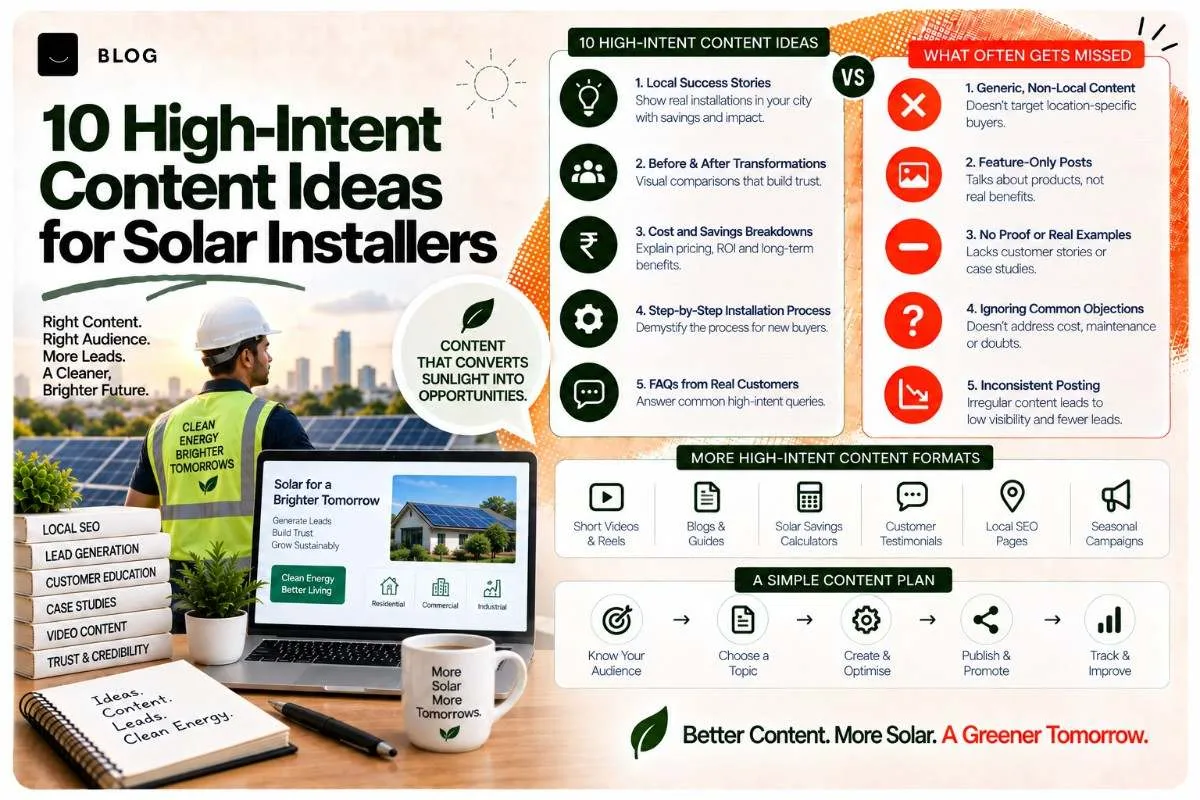
10 High-Intent Content Ideas for Solar Installers
High-intent solar content answers a question someone is asking right before they request a quote, not a question they might idly search months earlier. These ten ideas share one thing in common: every one of them can be written from knowledge your team already has, sitting in past project files and the same handful of questions asked on every sales call. None requires new research — only writing down what already exists.
What makes a solar content idea "high-intent"
Worth defining before the list, because it is the filter every idea below has to pass.
High-intent content addresses a decision point, not general curiosity. "What is solar energy" is low-intent — someone reading it is months from buying, if they buy at all. "How do I know if my roof gets enough sun for solar" is high-intent — someone asking that is actively evaluating whether to proceed. The ten ideas below sit deliberately at that second level.
The other filter: specificity from real experience beats general explanation every time. A generic "benefits of solar" post competes with thousands of identical posts. A cost breakdown from one real, specific installation competes with almost nothing, because almost nobody publishes real numbers.
1. A real cost breakdown for a completed installation
With the client's permission, a genuine cost breakdown for one real installation — system size, equipment, labour, permits, subsidy applied, final cost — presented plainly. This is the single most-wanted piece of information a prospective buyer cannot find anywhere, because almost every solar website quotes ranges or says "contact us for pricing."
VERIFY: Any specific cost figure must be current and accurate for the specific installation described, with client permission for publication.
2. "What size system do I actually need" — a working method
Not a generic explainer, but the actual method your team uses on a site visit to size a system — monthly consumption, roof area, orientation, shading. Written as a walkthrough someone could follow themselves, with the honest caveat that a real assessment still requires an actual site visit.
3. A subsidy walkthrough, kept current
The subsidy process, explained step by step, for the specific scheme relevant to your service area — what to apply for, what documents are needed, roughly how long it takes, and what commonly goes wrong in the process. This is one of the most-searched, most-anxious topics in solar, and it is also the content that decays fastest.
VERIFY: Every scheme detail, eligibility criterion and figure must be verified against current official documentation before publishing, and this content needs a standing quarterly review — flag it the moment it publishes.
4. On-grid vs off-grid vs hybrid, decided for a real situation
Not an abstract comparison, but a worked example: "for a household using X units a month in an area with reliable grid supply, here's how we'd typically approach this decision, and why." A decision framework grounded in a real scenario is more useful and more differentiated than a neutral feature comparison.
5. How to read and compare three quotes
What makes one quote legitimate and another inflated or incomplete. What to check for — equipment brand and specification, warranty terms, what is and is not included, installation timeline. This content builds trust precisely because it helps a buyer evaluate competitors fairly, not just your own company, and that visible fairness is what makes it credible.
6. What happens after installation — a realistic month one
A plain walkthrough of what a new solar owner should actually expect in the first month — commissioning, net metering activation, what the first bill looks like, how to read the system's output data. Genuinely useful, rarely published, and exactly the kind of specific procedural content that AI answer engines can extract cleanly.
7. A maintenance and cleaning explainer with real numbers
How often panels actually need cleaning in your specific climate and dust conditions, what a maintenance visit actually involves, and roughly what it costs — addressed honestly rather than oversold as "maintenance-free."
VERIFY: Any cost figure or maintenance frequency stated must reflect current, verified practice, not a rough guess.
8. What actually happens in bad weather
Addresses a common and reasonable buyer concern directly: how output changes on a cloudy or rainy day, and what genuinely happens to a system during heavy weather. Honest, specific answers to this exact question are rare, and the vagueness that usually substitutes for them is a real source of buyer hesitation.
9. Financing options, explained plainly
The financing routes actually available to customers — loans, EMI arrangements, any specific partnerships — explained in plain terms with the real trade-offs of each, not just a list of logos.
VERIFY: Any specific financing partner, rate or term must be current and verified before publishing.
10. The questions we get asked on every single call
Literally: sit with whoever answers the phone or handles first enquiries and write down the five questions that come up on nearly every call. This is, without exception, the fastest way to produce genuinely high-intent content, because it is a direct transcript of actual buyer uncertainty rather than a guess at what might be uncertain.
Where this content already exists in your business
The pattern across all ten ideas, worth naming explicitly: none of this requires new research. Every one of these already exists as knowledge inside your business — in a completed project file, in your sales team's head, in the questions your front desk fields every week. The work is not generating new information. It is writing down information that already exists and currently lives nowhere a customer, or an AI system answering a customer's question, can find it.
A practical way to start: pick the idea above that maps most directly to a conversation your team already has multiple times a week, and write that one first. It will be the easiest to write and very likely the highest-value.
Frequently asked questions
Content that answers a genuine decision-point question rather than general curiosity: real cost breakdowns, subsidy walkthroughs, how to compare quotes fairly, what happens after installation, and honest answers to common concerns like weather performance and maintenance. Specific, real-experience content consistently outperforms generic explanatory content in this category.
Because almost no solar company publishes real numbers, a genuine cost breakdown for one completed installation is rare, highly sought information that directly addresses the anxiety driving most solar buying hesitation. General pricing pages that quote ranges or say "contact us" answer nothing a hesitant buyer actually needs.
On a standing quarterly review at minimum, and immediately whenever a scheme changes. Subsidy information is high-value when accurate and can cause real financial consequences for a buyer acting on outdated figures, so no specific detail should be published without verification against current official documentation.
In information that already exists inside the business — completed project files, the sales team's knowledge, and the handful of questions asked on nearly every customer call. Writing down what already exists in institutional knowledge is faster and more valuable than researching generic topics from scratch.
Yes, and it works best grounded in a real scenario rather than presented as an abstract feature comparison. Explaining how a decision between on-grid, off-grid and hybrid would actually be approached for a specific type of household or situation is more useful and more differentiated than a neutral list of pros and cons.
It generally helps, because content that fairly explains how to evaluate any quote — not just the company's own — builds credibility precisely because it visibly serves the reader rather than only the business publishing it. That visible fairness is what makes the content trustworthy enough to influence a buying decision.
Specific, procedural, honestly-written content on exact buyer questions is precisely what AI answer engines extract and cite when responding to detailed solar-related queries. Generic content that could apply to any installer anywhere gives an AI system little to extract and nothing to distinguish one company from another.
Ready to build what's next?
Tell us where you're headed. We'll come back with a plan to get there.
Book an intro call